


A Series of Articles on The Five Maitreya Texts
In English, this text is commonly translated as The Ornament of the Mahayana Sutras".
In Sanskrit, the title is Mahāyānasūtrālaṃkāra or more fully the Mahāyānasūtrālaṃkārakārikā (महायानसूत्रालंकारकारिका)
In Tibetan it is the Do De Gyen (ཐེག་པ་ཆེན་པོ་མདོ་སྡེའི་རྒྱན་ཞེས་བྱ་བའི་ཚིག་ལེའུར་བྱས་པ།).
In Wylie it is theg pa chen po mdo sde'i rgyan zhes bya ba'i tshig le'ur byas pa.
This text is known in the Chinese tradition as the Da cheng zhuang yan jing lun (大乘莊嚴經論).
The Ornament of the Mahayana Sutras provides a comprehensive description of the bodhisattva’s view, meditation, and enlightened activities. Bodhisattvas are beings who, out of vast love for all sentient beings, have dedicated themselves to the task of becoming fully awakened buddhas, capable of helping all beings in innumerable and vast ways to become enlightened themselves. To fully awaken requires practicing great generosity, patience, energy, discipline, concentration, and wisdom, and Maitreya’s text explains what these enlightened qualities are and how to develop them.
Quite simply, the Sutralamkara is one of the most important texts in the Mahayana and Vajrayana traditions and is immensely important for practitioners and scholars to know intimately.
It is hard to exaggerate the importance of this text in the Tibetan tradition. It was first translated from Sanskrit to Tibetan in the 8th century, at the time of Padmsambhava, by his disciple Kawa Peltsek. Atisha later taught it when he came to Tibet and refers to it repeatedly throughout his works.
Mipham Rinpoche, paraphrasing Asanga's brother Vasubandu's student Sthiramati, says that this text:
. . .explains all the profound and extensive practices of the bodhisattvas, which can be summarized under three headings: what to train in, how to train, and who is training.
The first of these, what one trains in, can be condensed into seven objects in which one trains: one’s own welfare, others’ welfare, thatness, powers, bringing one’s own buddha qualities to maturity, bringing others to maturity, and unsurpassable perfect enlightenment.
How one trains is in six ways: by first developing a great interest in the teachings of the Great Vehicle, investigating the Dharma, teaching the Dharma, practicing the Dharma in accord with the teachings, persevering in the correct instructions and follow-up teachings, and imbuing one’s physical, verbal, and mental activities with skillful means.
Those who train are the bodhisattvas, of whom there are ten categories: those who are of the bodhisattva type, those who have entered the Great Vehicle, those with impure aspirations, those with pure aspirations, those whose aspirations are not matured, those whose aspirations are matured, those with uncertain realization, those with certain realization, those who are delayed by a single birth, and those who are in their last existence."
There are two excellent translations of this text, which both include Mipham Rinpoche's commentary, which are below, after which we will look at some of the other books in which this text is discussed.

$69.95 - Hardcover
A Feast of the Nectar of the Supreme Vehicle: An Explanation of the Ornament of the Mahayana Sutras
A monumental work and Indian Buddhist classic, the Ornament of the Mahāyāna Sūtras (Mahāyānasūtrālamkāra) is a precious resource for students seeking to study in depth the philosophy and path of Mahāyāna Buddhism. This full translation and commentary outlines the importance of Mahāyāna, the centrality of bodhicitta or the mind of awakening, the path of becoming a bodhisattva, and how one can save beings from suffering through skillful means.
This definitive composition of Mahāyāna teachings was imparted in the fourth century by Maitreya to the famous adept Asanga, one of the most prolific writers of Buddhist treatises in history. Asanga’s work, which is among the famous Five Treatises of Maitreya, has been studied, commented upon, and taught by Buddhists throughout Asia since its composition.
In the early twentieth century, one of Tibet’s greatest scholars and saints, Jamgön Mipham, wrote A Feast of the Nectar of the Supreme Vehicle, which is a detailed explanation of every verse. This commentary has since been used as the primary blueprint for Tibetan Buddhists to illuminate the depth and brilliance of Maitreya’s pith teachings. The Padmakara Translation Group has provided yet another accessible and eloquent translation, ensuring that English-speaking students of Mahāyāna will be able to study this foundational Buddhist text for generations to come.

$69.95 - Hardcover
Ornament of the Great Vehicle Sutras: Maitreya's Mahayanasutralamkara with Commentaries by Khenpo Shenga and Ju Mipham
In addition to Mipham Rinpoche's commentary, this volume also includes annotations by Khenpo Shenga. Between the two of them, they illuminate the subtleties of the root text and provide valuable insight into how to practice the way of the bodhisattva. Drawing on the Indian masters Vasubandhu and, in particular, Sthiramati, Mipham explains the Ornament with eloquence and brilliant clarity. This commentary is among his most treasured works.

$39.95 - Paperback
The Jewel Ornament of Liberation: The Wish-Fulfilling Gem of the Noble Teachings
Gampopa references the Ornament over two dozen times in this classic from the Kagyu tradition. E.g.
The Ornament of Mahayana Sutra says:
Generosity destroys its opposite,
Possesses the primordial wisdom of nonconceptual thought,
Fulfills all desires, and
Matures sentient beings in the three ways. And so forth.

$24.95 - Paperback
Three Visions: Fundamental Teachings of the Sakya Lineage of Tibetan Buddhism
The great Sakya master Ngorchen Konchog Lhundrub references the Ornament throughout this classic of the Sakya tradition, e.g.:
A person who is endowed with faith as explained above should cultivate it in a place like the one described in the mDo.sde rgyan (Sutralankara):
The place where the wise practice is an auspicious site,
with abundant provisions, well surrounded
with noble companions, and endowed with the
requisites of the practitioner's well-being.
More from the Nyingma Tradition
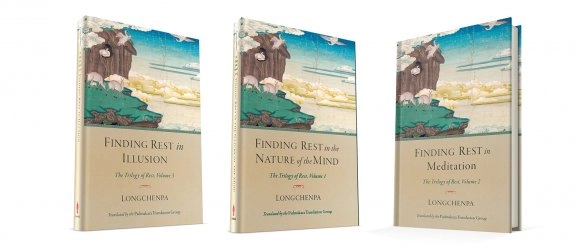
Longchenpa refers to it throughout his works, as Tulku Thondup repeatedly points out in The Practice of Dzogchen. It also appears in the recent translation of Longchenpa's Finding Rest trilogy.
Dudjom Rinpoche mentions it in his History of the Nyingma School, in The Nyingma School of Tibetan Buddhism, where he calls it the text that teaches “the integration of conduct and view.” He also refers to it repeatedly in A Torch Lighting the Way to Freedom when he is explaining the nature of the six perfections.The most comprehensive work on the Nyingma tradition, the multi-volume masterwork by Choying Tobden Dorje, The Complete Nyingma Tradition, also extensively references it.
Dudjom Rinpoche mentions it in his History of the Nyingma School, in The Nyingma School of Tibetan Buddhism, where he calls it the text that teaches “the integration of conduct and view.” He also refers to it repeatedly in A Torch Lighting the Way to Freedom when he is explaining the nature of the six perfections.The most comprehensive work on the Nyingma tradition, the multi-volume masterwork by Choying Tobden Dorje, The Complete Nyingma Tradition, also extensively references it.

$44.95 - Hardcover
$34.95 - Paperback

$34.95 - Paperback

$49.95 - Hardcover
$39.95 - Paperback
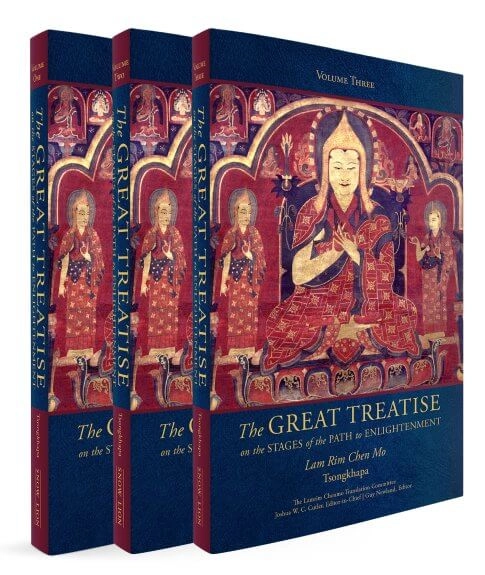
The Great Treatise on the Stages of the Path to Enlightenment
Tsongkahapa discusses the text throughout his Great Treatise on the Stages of the Path, the Lam Rim Chenmo. He uses it in the chapters on how to rely on a teacher; refuting misconceptions about meditation; on explaining the origin of suffering and emotions; the nature of the path leading to liberation, precepts and perfections; the paramita of perseverance, the perfection of wisdom, the gathering of disciples; and the various chapters on calm abiding meditation.
Additional Resources


In the next article in this series, we look at The Middle Beyond Extremes, the Madhyāntavibhāga
