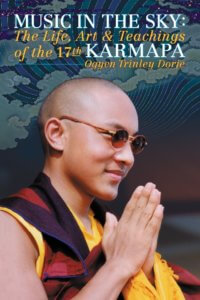
This article on reliance on a teacher originally appeared in the Snow Lion newsletter, Vol 12 #4, Fall 1997 Answers to Questions at the Tibetan Buddhist Learning Center, Washington, New Jersey, September 1990 Joshua Cutler: Americans in general are very wary of relying on one person and giving that person a lot of power andThe following article is from the Spring, 2003 issue of the Snow Lion Newsletter and is for historical reference only. You can see this in context of the original newsletter here. Ogyen Trinley Dorje Music in the Sky: The Life, Art and Teachings of the 17th Karmapa By Michele Martin The first authorized compilation
The Eight Kinds of Consciousness by Rangjung Dorje The Third Karmapa For the meditation on the nature of your own mind it is customary to ask your teacher for pointing-out instructions. Some practitioners are lucky enough to realize their true nature of mind straight away, whereas others merely perceive a sensation of it, a certain
The following is from the Snow Lion Newsletter, Winter Supplement 1995 Snow Lion: Rinpoche, can you tell us something about your activities here in the West? Lama Tharchin Rinpoche: Last time I saw my root teacher, His Holiness Dudjom Rinpoche, his final instructions were for me to take care of the doctrine by teaching andThe following is an excerpt from No Self, No Problem by Anam Thubten When awakening happens, there is no longer any desire to become someone other than who we are. Every previous idea of who we are vanishes and along with it the pain, guilt, and pride associated with our body. In Buddhism this isWhen we pray, what we are doing is invoking the spirit of devotion. Devotion is about no longer resisting anything. We are no longer trying to hold the composure of this illusory entity, ego or self. Self is always collapsing and dissolving in each and every moment. It dissolves if we leave it as itMipham Rinpoche on the Strength of Mantras Luminous Essence is a complete introduction to the world of tantric thought and practice. Composed by the renowned Tibetan master Jamgön Mipham (1846–1912), the text provides an overview of the theory and experiential assimilation of a seminal tantric scripture, the Tantra of the Secret Essence (Guhyagarbha Tantra). Embodying the essence ofAsanga glosses the term “meditative absorption” in the following manner: The term “meditative absorption” refers to [a state in which the mind] meditates correctly on an object and recollection holds fast [to an object] one-pointedly. The sutras describe each of the four meditative absorptions with a formulaic statement. Asanga glosses each expression that appears inFrom the Snow Lion Archive Enlightened Activity by Jamgön Mipham We’re all aiming to bring our actions more and more in accord with enlightenment. This excerpt from Luminous Essence by Jamgön Mipham offers a map of how that might look. In terms of its goal, enlightened activity can be either supreme or common. Supreme enlightenedEnlightenment happens unexpectedly, in the same way that we are often struck with wonder when we see whales jumping from the surface of the ocean. They take our breath away. Throughout the ages these kinds of experiences have often been experienced by meditators. This is frequently noted in the Buddhist tradition. The beauty of thisGelug presentations do not explain why the exhalation and inhalation of the breath is considered the best object of observation for “purifying” discursiveness. Simply, it works; the choice seems to be an empirical one, based on a long tradition of Buddhist practice. The governing principle seems to be that in systems asserting six consciousnesses, differentThe following article is an excerpt adapted from HH the Dalai Lama understands that questions (or “qualms”) naturally arise for students as they think about key Buddhist tenets. In this adaptation from his book Transcendent Wisdom (now published as Perfecting Wisdom)—translated and edited by B. Alan Wallace—he brings up qualms and gives his responses about what itThe following article is adpated from Daring Steps: Traversing the Path of the Buddha By Ringu Tulku Edited and translated by Rosemarie Fuchs Daring Steps$21.95 - PaperbackBy: Rosemarie Fuchs & Ringu Tulku Add to Cart When should we counteract our difficult emotions, and when should we go with their energy? How we are advised to dealThe following is a short excerpt from How Karma Works By Geshe Sonam Rinchen How Karma Works$22.95 - PaperbackBy: Geshe Sonam Rinchen & Ruth Sonam Add to Cart38 reviews on Amazon An Oral Teaching by Geshe Sonam Rinchen We all want to find happiness and be free from suffering. The twelve-part process of dependent arising showsThe Gelug View on Choosing an Object of Observation from Study and Practice of Meditation by Leah Zahler Study and Practice of Meditation$39.95 - PaperbackBy: Leah Zahler Add to Cart3 reviews on Amazon To choose an object of observation, a meditator may “investigate among various objects such as a Buddha image to see what worksOne cannot become a Buddha without both compassionate action and nondual wisdom—and one cannot have these two types of paths without both of the two truths, conventional and ultimate. If only emptiness existed and there were, in fact, no conventional truths, then there would be no living beings, no suffering to relieve; thus there wouldThe following excerpt is from Kindness, Clarity, and Insight by H.H. the 14th Dalai Lama Kindness, Clarity, and Insight$16.95 - PaperbackBy: H.H. the Fourteenth Dalai Lama & Elizabeth S. Napper & Jeffrey Hopkins Add to Cart81 reviews on Amazon Meditation The tenets of philosophical systems are to be practiced on the basis of a disciplinedScience shows that meditation is one of the best relaxants available Best-selling author David Michie takes a look at some of the psychological and physical benefits of meditation in these excerpts from his book, Hurry Up and Meditate. The most obvious physical change that occurs when we bring body and mind together in meditation isThe following excerpt is taken from The Wisdom of Imperfection by Rob Preece. One of my greatest challenges as a practicing Tibetan Buddhist of some thirty years has been to reconcile two worldviews—namely, those of Buddhism and Jung. By some coincidence, I first encountered both of these at the same time, while at university. Findingby Khenchen Konchog Gyaltshen OK, we haven’t exactly been angelic all our lives—and our “obscurations” are part of the cause. Buddhism prescribes certain steps to help purify our misdeeds. This clear description of those steps is adapted here from A Complete Guide to the Buddhist Path by Khenchen Konchog Gyaltshen. Application of the following fourIn this excerpt taken from the Introduction to The Treasury of Knowledge, Book Eight, Part Three: The Elements of Tantric Practice, the translator gives an interesting synopsis of aspects of practice that are covered in greater detail in the text. Kongtrul discusses many details of the creation-phase practice, including suitable places, times and durations ofGet out of the construction business! Stop building bridges across the raging waters of samsaric existence, attempting to reach the “far shore,” nirvana. Better to simply relax, at ease and carefree, in total naturalness, and just go with the primordial flow, however it occurs and happens. And remember this: whether or not you go withTilopa and the Attainment of Non-Attainment Tilopa (988–1069) Once, Tilopa advised his disciple to go off to an isolated retreat and avoid any meditation. Now, this may seem a little unusual for a meditation retreat. He explains, however, that when you go to meditate, you normally take up something to meditate on, some thing.These excerpts from The Psychology of Buddhist Tantra—one on retreat and the other on purification—are entertaining, knowledgeable, and rich with Preece’s hard-earned wisdom as a longtime Buddhist practitioner and psychotherapist. MEDITATION RETREAT The alchemical vessel of meditation retreat is very powerful. The Tibetan word for retreat, samlado, means, literally, “to sit or stay within boundaries,”The following excerpt is adapted from Reflections on a Mountain Lake By Jetsunma Tenzin Palmo Reflections on a Mountain Lake$27.95 - PaperbackBy: Jetsunma Tenzin Palmo Add to Cart What is the meaning of bodhichitta? What is the significance of the Bodhisattva Vow? If we limit ourselves to saying, “I vow to save all sentient beings,” that’sWhether it’s donuts, heroin, or praise that we crave, we all have addictive behaviors. This guide to beginning to break our compulsions is adapted from Chönyi Taylor’s book, Enough! A Buddhist Approach to Finding Release from Addictive Patterns. An addiction emergency happens when we suddenly find ourselves about to repeat an addictive pattern, or even Emptiness is perhaps the most important—yet difficult to define—topic in Buddhism. Guy Newland, author of Introduction to Emptiness—a kind of every-person’s guide to the intricacies of various explanations of emptiness—based his book on The Great Treatise on the Stages of the Path: The Lamrim Chenmo by Tsong-kha-pa, of which he was the editor. HereThe following excerpt is adapted from The Dark Red Amulet: Oral Instructions on the Practice of Vajrakilaya By Khenchen Palden Sherab and Khenpo Tsewang Dongyal The Dark Red Amulet$29.95 - PaperbackBy: Khenpo Tsewang Dongyal Rinpoche & Khenpo Tsewang Dongyal & Khenchen Palden Sherab Add to Cart60 reviews on Amazon In his Dzogchen teachings, Guru Padmasambhava urgedSetting Motivation Breathing Exercises with Leah Zahler adapted from Study and Practice of Meditation: Tibetan Interpretations of the Concentrations and Formless Absorptions Study and Practice of Meditation$39.95 - PaperbackBy: Leah Zahler Add to Cart3 reviews on Amazon Because of the interdependence of the body, channels, winds, and mind, the breath becomes a means ofDealing with Demons an excerpt from Tantric Techniques by Jeffrey Hopkins Tantric Techniques$32.95 - PaperbackBy: Jeffrey Hopkins Add to Cart9 reviews on Amazon When we do deity yoga we need to be very careful that our unconscious contents don’t arise and mix into the practice or get projected. There could be no better guide through