
A Series of Articles on The Five Maitreya Texts
The Five Maitreya Texts, or Five Treatises of Maitreya (Tib. Jam Chö De Nga, Wylie. byams chos sde lnga) are essential texts focused on the Mahayana path for all the traditions in Tibet.
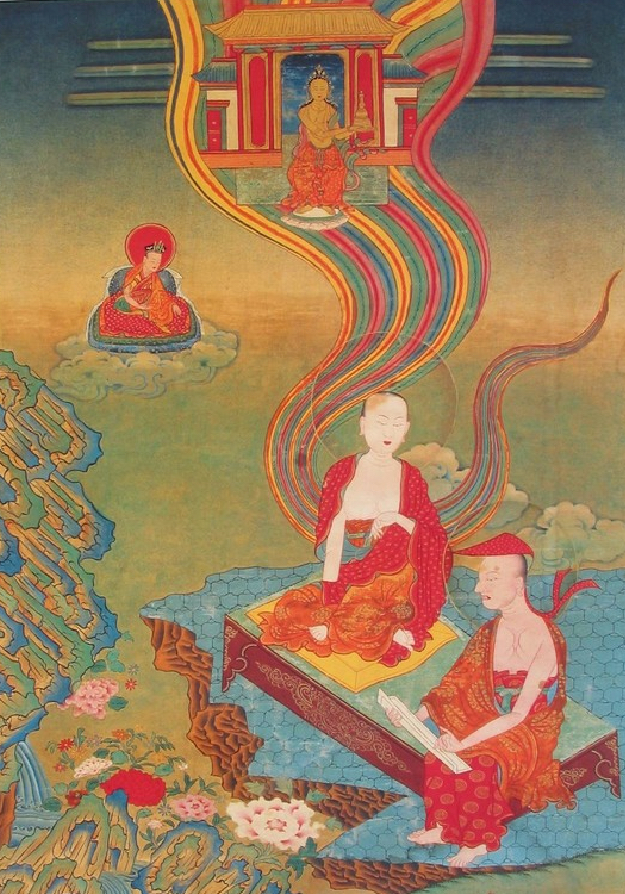
According to tradition, these texts are all teachings that the Bodhisattva Maitreya imparted to Asanga in the fourth century. They are studied by all the traditions in Tibetan Buddhism, though interpreted in a variety of ways.
Here is the story as told in the introduction by the Dharmachakra Translation Committee to their translation of one of these texts, The Middle Beyond Extremes:
Twelve long years of austere practice in solitary retreat had brought the noble Asaṅga to an extraordinary level of spiritual maturity. In turning to Maitreya, Regent of the Buddha Śākyamuni and embodiment of perfect love, his heart and mind had become profoundly receptive, moistened and nourished by the waters of love. Yet while his spiritual awakening was soon to set in motion a liberating wave of events that would reach millions, Asaṅga was not aware of the deep changes that had been taking place within himself. In fact, he saw himself as a failure. His heart was as cold as ever, he thought, and the vision of the profound reality that the Buddha had discovered remained a distant and elusive dream. During his many years in retreat he had been at the verge of complete despair before, but each time some incident had occurred that would remind him both of the futility of mundane pursuits and the power of perseverance. This time, however, all hope for accomplishment had left him. Distressed by what he felt was a complete lack of progress, Asaṅga sadly decided to leave his hermitage for good.
As the dejected yogi walked the painful path back to the world of men—a world he had thought only to return to once he would be able to share with it the liberating elixir of the divine Dharma—he came across a sick and howling dog, lying by the wayside. Asaṅga stopped, and as he looked closer he saw that the dog suffered from a large open wound, infested with maggots. This pitiful sight moved Asaṅga deeply. Forgetting his depression, he knelt down by the dog and tried to think of a way that he could save it from the invading parasites without hurting the maggots or depriving them of their necessary sustenance. A solution came to his mind. Having obtained a sharp knife from a nearby village, Asaṅga resolutely cut a piece of flesh from his own thigh and placed it on the ground next to the howling and snapping dog. Intending to carefully lick off the maggots with his tongue, and then transport them safely to this fresh lump of food, he now drew his face close to the dog’s oozing wound. Revolted by the sight of the maggots feasting on the rotting flesh, Asaṅga closed his eyes. But his tongue never reached the wound. Puzzled, Asaṅga opened his eyes, and at that very moment, suddenly and miraculously, he experienced the overwhelming presence of the master of infinite love.
Finally, he had come face to face with radiant beauty and profound brilliance; Maitreya stood before him. “Why,” Asaṅga found himself exclaiming, “have you waited so long? How could you not respond to my calls?” “I was always with you,” answered the great Bodhisattva, “but it is only now that your compassion has become strong enough to sweep away the veils in your mind, which have kept my presence unknown to you.” To prove his point to a still rather doubtful Asaṅga, Maitreya asked to be brought to the nearby village. Asaṅga, carrying Maitreya on his shoulders, went through the entire settlement, yet it became clear that none of the villagers could see the great Bodhisattva. Deeply moved, Asaṅga now once more repeated the supplication that had been on his lips throughout his years in retreat: “Reveal to me the definitive meaning, the profound intent of the sūtras of transcendent knowledge!”
In an instant, Asaṅga was transported to the heavenly realm of Tuṣita, and here Maitreya revealed to him the full beauty of the Supreme Vehicle, showing him the inconceivably profound and vast meanings that liberate the hearts of the Bodhisattvas and enable them to lead all beings into consummate enlightenment. When Asaṅga returned to this world he was transformed, a living treasury of the Dharma. Imbued with Maitreya’s powerful teachings, he entered history as the master who established the Approach of Vast Activity, and so, comparable only to Nāgārjuna, he continues to render unimaginable service to the teachings of the Buddha and to sentient beings.
In this way the Tibetan masters Buton (bu ston, 1290-1364) and Tāranātha (born 1575) describe the emergence of Maitreya’s Five Teachings (byams chos sde lnga)1 in this world. Upon his return from Tuṣita, Asaṅga committed some of Maitreya’s teachings to writing...
The Five Texts
Jamgon Kongtrul Lodro Thaye said this of the five texts:
First, [Maitreya] composed the Abhisamayālaṃkāra, which teaches the coarse dharma terminology of the Great Madhyamaka of definitive meaning in merely an abbreviated manner. Then, in the Mahāyānasūtrālaṃkāra, Madhyāntavibhāga, and Dharmadharmatāvibhāga, he explained it clearly and extensively. Finally, in the Uttaratantra, he ascertained the fine details of the philosophical system of the uncommon meaning of the sūtras on the [Tathāgata] heart.
Karl Brunnholzl, in his introduction to When the Clouds Part, relates,
In the different schools of Tibetan Buddhism, there is just about every possible interpretation as to what each one of these five texts by Maitreya teach, what their intentions are, and which of them belong to Yogācāra or what Tibetans call "Mere Mentalism" (sems tsam), Yogācāra-Madhyamaka, *Svātantrika-Madhyamaka, *Prāsaṅgika-Madhyamaka, Shentong Madhyamaka, or "Great Madhyamaka." However, despite these differences, what is clear for most commentators is that, in terms of their contents, these five texts cover the entire range of the mahāyāna teachings.
It is notable that these texts as a group are really only thought of as such in Tibet. In China, only a few of these texts were studied and were less influential.
As Brunnholzl allso relates,
The Chinese Buddhist tradition also speaks of “the five works of Maitreya,” but considers them as consisting of the Yogācārabhūmi, a *Yogavibhāga, the Mahāyānasūtrālaṃkāra, the Madhyāntavibhāga, and the Vajracchedikāvyākhyā.285 The Abhisamayālaṃkāra was never translated into Chinese and seems to be completely unknown in the Chinese Buddhist tradition. The Dharmadharmatāvibhāga was translated only once in 1936 by Fa-tsun (1902–1980) and plays no significant role in Chinese Buddhism, while the Uttaratantra is ascribed to a certain Sāramati.
The five texts are listed in various orders but what follows is a common one, and we include how each is glossed in Butön’s History of Buddhism in India and Its Spread to Tibet: [we changed the titles in the translation of Butön to match the headings below]
1. The Ornament of Clear Realization, the Abhisamayālaṃkāra
comments on the emptiness taught in the Prajnaparamita Sutras and on what happens in the minds of bodhisattvas familiarizing themselves with emptiness on the paths and bhumis.
2. The Ornament of the Mahayana Sutras, the Mahāyānasūtrālaṃkāra
This is a synopsis of all topics of those mahayana sutras that are not covered by The Ornament of Clear Realization and The Ultimate Continuum of the Mahayana.
From Butön:
The Ornament of the Mahayana Sutras presents all great way teachings in a summary of five points:
Like wrought gold, like a blossomed lotus,
Like a well-cooked meal eaten by those who were close to starving,
Like hearing good news, like opening a box of gems:
Such teachings are explained here. Be supremely joyful.
3. The Middle Beyond Extremes, the Madhyāntavibhāga
This treatise explains the vast paths of all three yanas, emphasizing the view of Yogācāra (including the Yogācāra Middle Way) and the distinctive features of the mahāyāna. From Butön:
In The Middle Beyond Extremes, “extremes” refers to the views of existence and nonexistence, or eternalism and nihilism. “Middle” refers to the path of the middle way, having rejected those two [extremes], thus The Middle Beyond Extremes. It presents its subject in seven points:
This is the highest way:
The characteristics, obscurations, the absolute,
Antidotes, meditation,
Its subjects, and the attainment of the result.
4. The Distinction Between Phenomena and Their Nature, the Dharmadharmatāvibhāga
This work discusses the difference between samsaric confusion and the liberating power of nonconceptual wisdom-the heart essence of all profound sutras.From Butön:
In The Distinction Between Phenomena and Their Nature “phenomena” refers to the wheel of life’s phenomena, the thoroughly afflictive emotions. “The nature of reality” refers to the phenomena of transcendent states. This treatise presents the difference between them, thus The Distinction Between Phenomena and Their Nature.
5. The Ultimate Continuum of the Mahāyāna, the Ratnagotravibhāga (Uttaratantra)
This is a general commentary on buddha nature and represents a bridge between sutra and tantra. From Butön:
The Ultimate Continuum refers to the highest phenomena of the great way’s continuity or continual stream. It is given this title because these are the foremost among phenomena. Otherwise, [in the Sanskrit title,] uttara can mean “later,” thus its title refers to its being a commentary on the final turning of the wheel in the great way’s continuity [of instruction]. It presents seven subjects: the three jewels [as separate subjects]; their underlying cause, the enlightened constituent; the result, awakening; the sixty-four qualities of enlightenment; and enlightened activity. As the text states:
The whole body of the treatise can be resumed
In these seven vajra points:
Buddha, the Teachings, the Spiritual Community, the constituent, awakening, and qualities.

$34.95 - Hardcover
Books on the Five Maitreya Texts
While many of the books on the text-specific pages that follow discuss all five of the Maitreya texts, here are a few that discuss them as a group.
Also, both When the Clouds Part (which focuses on The Ornament of Clear Realization) and Mining for Wisdom within Delusion (which focuses on The Middle Beyond Extremes) have a duplicate section in their introductions entitled “The History and Transmission of ‘The Five Dharmas of Maitreya’ from India to Tibet” that lists and analyzes the five texts. It discusses authorship debates, differences between Tibetan and Chinese lists, and transmission history .

$78.00 - Hardcover
The Center of the Sunlit Sky: Madhyamaka in the Kagyu Tradition
This work by Karl Brunnholzl discusses all five texts.
He relates how the Eighth Karmapa’s (and his teacher Sangye Nyenpa’s) view that all five dharmas of Maitreya are commentaries on the entire corpus of the Buddha’s causal and resultant Great Vehicle teachings.
He relates how the three middle treatises (Mahāyānasūtrālaṃkāra, Madhyāntavibhāga, Dharmadharmatāvibhāga) explicitly teach the distinct Yogācāra system, though they also touch on Madhyamaka.
The first (Abhisamayālaṃkāra) is “common” to Madhyamaka and Yogācāra.
The last (Uttaratantra) is “common” to sūtra and tantra.

$150.00 - Hardcover
A Compendium of the Mahayana: Asanga’s Mahayanasamgraha and Its Indian and Tibetan Commentaries
This work by Karl Brunnholzl is focused on Mahāyānasaṃgraha and ālaya‑consciousness, but it explicitly treats the three natures as formulated in Yogācāra (drawing also on texts like Triṃśikā). The Five Maitreya texts all appear throughout this work in hundreds of places.

$32.95 - Paperback
Luminous Heart: Essential Writings of Rangjung Dorje, the Third Karmapa
This work by Karl Brunnholzl includes an excellent overview of the five texts with example of how differently they are interpreted across the various traditions within Tibetan Buddhism.
Twelve long years of austere practice in solitary retreat had brought the noble Asaṅga to an extraordinary level of spiritual maturity. In turning to Maitreya, Regent of the Buddha Śākyamuni and embodiment of perfect love, his heart and mind had become profoundly receptive, moistened and nourished by the waters of love. Yet while his spiritual awakening was soon to set in motion a liberating wave of events that would reach millions, Asaṅga was not aware of the deep changes that had been taking place within himself. In fact, he saw himself as a failure. His heart was as cold as ever, he thought, and the vision of the profound reality that the Buddha had discovered remained a distant and elusive dream. During his many years in retreat he had been at the verge of complete despair before, but each time some incident had occurred that would remind him both of the futility of mundane pursuits and the power of perseverance. This time, however, all hope for accomplishment had left him. Distressed by what he felt was a complete lack of progress, Asaṅga sadly decided to leave his hermitage for good.
Additional Resources

The next article in the series is a guide to the first text, Ornament of Clear Realization or the Abhisamayālaṃkāra.