
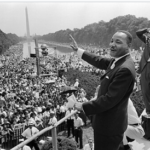

For many people, Martin Luther King Jr. Day has become little more than a welcome day off in January—a chance to sleep in, catch up on chores, or spend time with friends, perhaps accompanied by a vague sense of appreciation for some version of King we learned about in school.
At Shambhala Publications, while we also close the office, we try each year to lean more fully into the living spirit of Dr. King’s legacy. This year, instead of turning directly to King’s own words, we’ve turned to the novelist and essayist Charles R. Johnson, whose non-fiction collection Taming the Ox: Buddhist Stories and Reflections on Politics, Race, Culture, and Spiritual Practice includes a powerful piece titled “The King We Need.”
Returning to this essay now, we were struck by how piercingly relevant Johnson’s vision of King remains—not just in the United States, but across the globe. The reflections that follow lift up only one dimension of a deeply nuanced, far-reaching essay that traces the full arc of King’s life, work, and moral courage.
Re-reading this essay this year, we were moved to see how painfully relevant it is all around the globe today. What follows only highlights one aspect of this moving essay that looks at the entire arc of King's life and work.
In what follows, Johnson discusses what he describes as King’s “three transcendentally profound theses” on his early work:

-
- Nonviolence
Johnson explores the depth of this when he says that “nonviolence—in words and actions—must be understood not merely as a strategy for protest but as a Way, a daily praxis men must strive to translate into each and every one of their deeds, so that, in its fullness King’s moral stance implies noninjury (ahimsa) to everything that exists.”
- Agape
Johnson describes this as “the ability to unconditionally love something not for what it presently is (for at a particular moment it might be quite unlovable, like the segregationist George Wallace in the early 1960s) but instead for what it could become, a teleological love that recognizes everything as process, not product, and sees beneath the surface to a thing’s potential for positive change—the kind of love every mother has for her (at times) wayward child.”
- Integration and Interdependence
Johnson unpacks King’s intention here as follows:“And last, he understood integration and interdependence to be the life’s blood of our being, proclaiming, ‘It really boils down to this: that all life is interrelated. We are all caught in an inescapable network of mutuality, tied in a single garment of destiny. Whatever affects one directly, affects all indirectly.’In effect, King understood that our lives are already tissued, ontologically, with the presence of Others in a We-relation the recognition of which moves us to feel a profound indebtedness to our fellow men and women, predecessors and ancestors.‘When we get up in the morning,’ he said, ‘we go into the bathroom where we reach for a sponge provided for us by a Pacific Islander. The towel is provided by a Turk. We reach for soap created by a Frenchman. In the kitchen, you drink coffee provided by a South American, or tea by a Chinese, or cocoa by a West African, and you butter toast from an English-speaking farmer. And before you’ve finished breakfast, you’ve depended on more than half the world. . . . This is the way our universe is structured. This is its interrelated quality. We aren’t going to have peace on earth until we recognize this basic fact of the interrelated structure of the universe.’
'And if our destinies are so intertwined, it follows that ‘strangely enough, I can never be what I ought to be until you are what you ought to be. You can never be what you ought to be until I am what I ought to be.’
Little wonder, then, that when King entered Stage Two of his evolution, which I date from the day he received the Nobel Peace Prize, he envisioned himself not merely as a southern civil rights leader but instead as a man obligated to promote his belief in the “beloved community” and peace on the world stage—a stance that would make him the first international celebrity to oppose the Vietnam War (and a comrade of a young monk named Thich Nhat Hanh, whom King nominated for that prize).
- Nonviolence