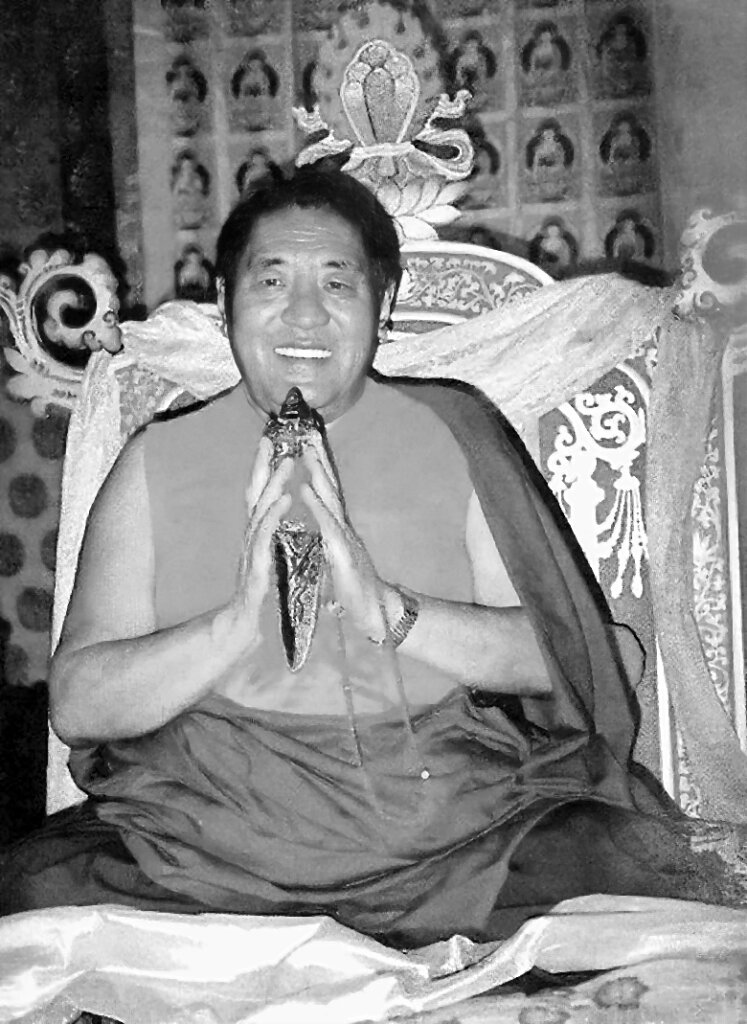
Khenpo Jigme Phuntsok, image from Golden Garuda
Khenpo Jigme Phuntsok, founder of Larung Gar. Image from Golden Garuda

About Larung Gar

Larung Gar, or “The Encampment of the Larung Valley”, is a magical, incredible place.  Located in the remote high-altitude grasslands in the region of Golok in the far east of Tibet, outside of the Chinese demarcated Tibetan Autonomous Region in the province of Sichuan, it is has become home to the world’s largest Buddhist institute of study and practice. It is a striking place.  Founded in the late 1800s by Dudjom Lingpa, the predecessor of Dudjom Rinpoche, it is most famous today for the community that grew around the incredible master Jigme Phuntsok Rinpoche (1933-2004).

It is now filled with tens of thousands of practitioners.  There are monks, nuns, yogis and yoginis, and many lay people studying Mahayana and Vajrayana, and there are people from all the Tibetan schools there.  It has, with some ups and downs, been able to thrive and stay out of politics, focusing only on the Four Pursuits whose purpose Khenpo Sodargye, one of its leaders, describes as “to unite Buddhists in harmony; to uphold pure precepts; to study, reflect upon, and practice the sacred Dharma; and to propagate the Dharma and benefit all beings.”

The students of Jigme Phuntsok are having a huge impact on the spread of Dharma well beyond these remote grasslands.  Here is a profile of Jigme Phuntsok RInpoche himself as well as just a few of the teachers who trained under him and are currently making an incredible mark on Buddhism the world over.

Voices from Larung Gar: Shaping Tibetan Buddhism for the Twenty-First Century

Voices from Larung Gar is the first collection of talks and writings by the leading voices of Larung Gar, the largest Buddhist institution on the Tibetan plateau. The book offers a compelling vision for Buddhism in the twenty-first century by some of the most erudite, creative, and influential Tibetan Buddhist luminaries today. In everyday language, these leaders delve into an array of contemporary issues, including science, ethics, gender equity, and animal welfare.

This collection features contributions from a range of prominent figures who are forging dynamic, modern paths forward for an ancient tradition. Included are the internationally renowned Khenpo Jigme Phuntsok, founder of Larung Gar, his distinguished successors Khenpos Sodargye and Tsultrim Lodro, and erudite nuns holding the scholarly title Khenmo, who are becoming known for their impressive publishing projects. Larung Gar is thus one of Tibetan Buddhism’s most vital communities, actively balancing cultural preservation and innovation.

A  Symposium on Voices from Larung Gar. 

Panel 1: Larung Gar, Its Impact and Founding Figures featuring Anam Thubten, David Germano, and Antonio Terrone, moderated by Holly Gayley.

Panel 2: Voices of Second Generation at Larung Gar on Buddhist engagement with animal rights, gender equality, and science, moderated by Michael Sheehy, with Padma 'tsho, Geoff Barstow, Sarah Jacoby, and Catherine Hardie.

I am deeply honoured and grateful for the opportunity to remark on the writings of the eminent teachers of Larung Gar, especially the heart sons of the great and formidable Kyabje Khenchen Jigme Phuntsok Rinpoche. My observations of both Khenpo Tsultrim Lodro and Khenpo Sodargye over the years have turned gradually to admiration and then to real veneration. Their “walk the talk” approach to the dharma they teach gives great hope to all followers of the Buddhadharma. And so, I want to express my joy that having their words now in printed form will provide at least a glimpse of the unfathomable and infinite activity of these great teachers from Larung Gar.
—Dzongsar Khyentse Rinpoche, on Voices from Larung Gar

The Leaders of Larung Gar

Khenchen Jigme Phuntsok Rinpoche

See also Lotsawa House’s collection of translations by Jigme Phuntsok Rinpoche.

The Golden Garuda: The Extraordinary Life of Modern-Day Mahasiddha Jigme Phuntsok Rinpoche

Jigme Phuntsok Rinpoche (1933–2004) was one of the most influential Buddhist teachers of the twentieth century. In this moving biography, Khenpo Sodargye—a lead teacher at Larung Gar Five Sciences Buddhist Academy—brings his beloved root teacher’s remarkable story and accomplishments to life with wisdom and reverence. His personal anecdotes coupled with the prophecies of great masters and verse from Buddhist texts offer a portrait that is at once intimate and profound, revealing Jigme Phuntsok’s legacy as the mythical “golden garuda” who was instrumental in the flourishing of Buddhism. During a pivotal period in modern Tibetan history, he created the world’s largest Buddhist institution, attracted thousands of followers with his nonsectarian teachings, and taught some of today’s great Tibetan Buddhist teachers.

The engaging narrative unfolds chronologically in dozens of short, impactful chapters. We’re introduced to Jigme Phuntsok’s previous incarnations and learn about his early years. We experience his teaching trips, including a journey to the holy Mount Wutai in China together with ten thousand Tibetan disciples. We learn about his visionary experiences and revelations, including one that failed—a rare account in Tibetan literature of such an occurrence. With elements of biography, travelogue, and magical tale, this life story contains adventure, suffering, and human connection.

This portrayal of the great Jigme Phuntsok Rinpoche’s compassionate life dedicated to spiritual practice and teaching will inspire Buddhist practitioners and meditators and readers with an interest in modern Tibetan and Buddhist history.

"The memory of his shockingly confident, authentic presence is unforgettable, along with his tireless enthusiasm to benefit others accompanied with profound lineage transmissions mostly given by heart. In these times, when meeting such an authentic master is as rare as a daytime star, this book—like the sighting of a Golden Garuda—gives us a renewed sense of hope and faith in the timeless wisdom of the Mahayana, Vajrayana, and Ati Yoga traditions."
Sangye Khandro, cofounder of Light of Berotsana Translation Group

Always Present: The Luminous Wisdom of Jigme Phuntsok

From Khenpo Sodargye's preface to Always Present:

On the occasion of the tenth anniversary of His Holiness’s parinirvana, I began an exhaustive search through the recordings of the teachings he gave both at home and abroad. From these, I selected some teachings and translated them as an offering to all who have an affinity with His Holiness. As the First Dodrupchen Jigme Trinle Özer prophesied over two hundred years ago, any being that forms a connection with His Holiness Jigme Phuntsok Rinpoche can be reborn in a pure land of great bliss. It is therefore auspicious that His Holiness’s teachings are now being shared.

"Khenpo Sodargye’s teachings, techniques, and guidance are not only those of a highly accomplished scholar but also reflect his vast practical experience in working with people of greatly different capacities and backgrounds. I deeply treasure Khenpo’s words and teachings in this book."

Dzongsar Jamyang Khyentse Rinpoche,

Khenpo Tsultrim Lodro

khenpo-tsultrim-lodro

Khenpo Tsultrim Lodro, one of the main contributors to Voices from Larung Gar above, is one of the leading teachers at Larung Gar and also has many thousands of students.  Shambhala was very honored to have a visit from him in 2014 where we discussed Buddhist publishing and Dharma in the west.

Official Website

Lama Mumtso (Jetsünma Mumé Yeshe Tsomo)

Lama Mumtso

Lama Mumtso is the niece of Khenchen Jigme Phuntsok and renowned as an incarnation of Jetsün Mingyur Paldrön.  She is one of the most revered leaders at Larung Gar.

Lotsawa House has some translations of her work and further teachings can be found on Khenpo Sodargye's website, as well as in Voices of Larung Gar.

Khenpo Sodargye

Khenpo Sodargye was born in 1962 into a nomadic family in a small valley of the Tibetan region of Kham. He was ordained in 1985 and went on to become a lineage holder of the Great Perfection (Dzogchen) tradition, as well as a preeminent practitioner and scholar at Larung Gar Five Sciences Buddhist Academy in Sertar. Khenpo Sodargye was the great Jigme Phuntsok Rinpoche’s chief Tibetan-Chinese translator. He has traveled extensively in North America, Europe, Africa, and Asia to offer teachings at Dharma centers and universities.

As a Tibetan high lama of Nyingma Lineage, Khenpo endorses Rimé spirit and offers teachings from a variety of Buddhist lineages to hundreds of thousands of worldwide students. Khenpo emphasizes a systematic approach of listening, contemplating and meditating on the Dharma. He has been teaching traditional Mahayana Buddhism such as The Way of Bodhisattva, The Ornament of the Middle Way and the whole collection of Five Great Treaties since 1987.

As a Vajra guru and a Dzogchen lineage holder, Khenpo is empowered to transmit Vajrayana teachings and practices such as Yeshe Lama, Lama Yangtik, Seven Treasuries, Trilogy of Rest, Trilogy of Natural Freedom, The Guhyagarbha Tantra, The Dzogchen Practice of Peaceful Manjushri, and much more.

As an experienced meditator of high level realization, Khenpo believes that meditation goes beyond sitting practice. Using a Mahayana approach, he promotes “Meditation in Life” which helps people reach a meditative state of mind even while walking, talking, eating and cooking.

Khenpo has translated, from Tibetan to Chinese or vice versa, more than 100 sutras, shastras, commentaries, liturgies, and pith instructions of Mahayana and Vajrayana Buddhism in the past 30 years.

Since 2010, in order to extend the spirit of wisdom and compassion, the essence of Buddhism, to an even wider audience, Khenpo has given talks at more than 100 universities across world. Their topics are as diverse as happiness, compassion, meditation, Buddhist psychology, and Buddhism in Modern Society.

Tibetan Buddhist: A Guide to Contemplation, Meditation, and Transforming Your Mind

by Khenpo Sodargye

This guide shares Tibetan Buddhist insight and tools that will benefit everyone in transforming their mind. Khenpo Sodargye, who has attracted hundreds of thousands of students worldwide with his concise, easy-to-follow teaching style, sketches the big picture of the Mahayana path in straightforward language with stories relevant to everyday life. He draws on authentic texts and teachings by renowned Buddhist masters to explain complex concepts like:

  • The Four Dharma Seals
  • Faith
  • Bodhicitta
  • The Three Supreme Methods
  • The Two Truths
  • Rebirth and karma
  • Spiritual teachers
  • The Great Perfection

This book introduces a systematic approach to studying Buddhism. Through proper listening, contemplating, and meditating, we can generate the wisdom that enables us to recognize, control, and uproot our afflictions, which is the essence of Buddhism. This book is the perfect companion for anyone wanting to learn more about the basics of Mahayana Buddhism or to strengthen the foundations of their spiritual practice.

"Khenpo Sodargye’s teachings, techniques, and guidance are not only those of a highly accomplished scholar but also reflect his vast practical experience in working with people of greatly different capacities and backgrounds. I deeply treasure Khenpo’s words and teachings in this book."

Dzongsar Jamyang Khyentse Rinpoche,

Important Teachers from Larung Gar

Orgyen Chowang Rinpoche

Orgyen Chowang Rinpoche is the founder of the Pristine Mind Foundation was one of the first group of Khenpos trained by Jigme Phuntsok Rinpoche.  Orgyen Chowang Rinpoche released his first book, Our Pristine Mind: A Practical Guide to Unconditional Happiness in the spring of 2016 to very enthusiastic reviews from both long-time practitioners and people completely new to Buddhism – a rare pairing.  In the foreword, he briefly describes his experience at Larung Gar:

"At the age of fourteen I received the rare opportunity to become a  stu­dent of one of the greatest enlightened masters of the twentieth century, Jigme Phuntsok Rinpoche. I left home and started my studies at Larung Gar, my teacher’s famous retreat center. The living conditions at Larung Gar at that time were harsh, with very cold winters, scanty food, and few comforts. For the first year I lived on my uncle’s porch, with only a cur­tain protecting me from the snow. After that, my parents built me a small house, where I stayed for the next eight years of my training. Even though the living conditions continued to be challenging, they never felt too dif­ficult to bear. In fact, this was a time in my life when I experienced tre­mendous joy.

"During these nine years, my focus was on studying the canon of Bud­dhist literature, particularly the advanced teachings known in Tibet as Vajrayana and Dzogchen. But my studies were not just dry reading and test taking, as you might imagine. I found great inspiration and joy through singing “vajra songs”—poems that have arisen in the minds of enlight­ened masters out of their meditation experiences. These poems express extraordinary wisdom. After each day of class and study, I went back to my little house and sang many vajra songs, particularly those of the great masters Longchenpa (fourteenth century) and Mipham Rinpoche (nine­teenth century).

"After many years of study, I was given the title Khenpo, the rough equivalent of a Ph.D. It indicates having a full understanding of the Bud­dhist literature and also means having achieved some degree of meditation experience, so that I was qualified to give teachings and guide others in their practice as well. Overall, the training I received during these years gave me the knowledge and practical tools I needed in order to lead a life of fulfillment and transformation, for both myself and others."

Official Website

Orgyen Chowang Rinpoche's Books:

Our Pristine Mind: A Practical Guide to Unconditional Happiness

The true nature of our mind is brilliant, clear, and joyful. But we don’t experience this reality amid the swirl of stresses, thoughts, and emotions of day-to-day life. Our Pristine Mind is a practical guide to uncovering our naturally comfortable state of mind and reconnecting with the unconditional happiness that is already within us. Using straightforward, accessible language, Orgyen Chowang Rinpoche leads us through the path of Pristine Mind meditation, a practice from the profound teachings known as Dzogchen. This book presents the entire journey of meditation, from the very beginning all the way to the complete happiness of enlightenment. It is a realistic, natural process that can be practiced and experienced by anyone.

"A beautiful and potentially life-altering book. The teachings here, at once ancient and revolutionary, are offered with astonishing frankness, clarity, and affection. I felt myself improved by my first read and will be going back to read it again at once."
George SaundersNew York Times best-selling author of Tenth of December and Lincoln in the Bardo

From Foundation to Summit: A Guide to Ngöndro and the Dzogchen Path

In this book, Orgyen Chowang Rinpoche brilliantly explains how to engage in the foundational practice according to the New Treasures of the Dudjom tradition, the Dudjom Tersar. And from the outset, Orgyen Chowang introduces the pristine teachings of Dzogchen, the pinnacle of the Nyingma path, to provide the context that informs every stage of the path to awakening.

This book is based on a series of oral teachings on Thinley Norbu’s text A Cascading Waterfall of Nectar, itself a teaching on the Dudjom Tersar, that Orgyen Chowang gave to Western students over a three-month period in 1997. He explains in a very fresh, uncomplicated way such topics as receiving the blessings from the lama, the nature of awakening, the role of pointing-out instructions, tranquility and insight meditation, the three bodies of enlightenment, and the Dzogchen practices of trekchöd (cutting through) and thögal (passing over). This book will be of immense benefit to those engaged in the Dudjom Tersar ngöndro, those who have already finished their ngöndro accumulations, and those engaged in the foundational practice from other Nyingma lineages.

"I feel sure that the publication of Orgyen Chowang’s commentary on Thinley Norbu’s A Cascading Waterfall of Nectar will be of immense benefit, and my aspiration is that it will inspire the blessings and fearlessness of the great tertön Dudjom Lingpa to shower down ceaselessly on this earth."
Dzongsar Jamyang Khyentse, author of Living Is Dying

The Tibetan Book of Success: A Guide to Relationships, Leadership, Communication, and Happiness

Drawn from a long tradition of secular Tibetan teachings on how to live a good life, these four texts from Tibetan masters provide clear and succinct instructions for creating happiness, success, harmonious relationships, and just communities. These teachings continue to be emphasized at Larung Gar

In the spirit of the writings of the Stoics, Dale Carnegie, Stephen R. Covey, Viktor Frankl, Don Miguel Ruiz, and others, these texts reveal that for centuries, Tibetan wisdom has extolled principles and values like honest communication, integrity, decency, fairness, reliability, respect, and generosity as the foundation for a good life.

Translated by meditation master Orgyen Chowang Rinpoche, founder of the Pristine Mind Foundation, the collection includes an 8th-century scroll from the Dunhuang caves as well as writings from some of the greatest luminaries of the Tibetan tradition: Sakya Pandita (1182-1251), Jamgon Mipham Rinpoche (1846-1912), and Patrul Rinpoche (1808-1887).

With a message that’s more relevant than ever in our chaotic, disconnected times, The Tibetan Book of Success explains how leaders, entrepreneurs, parents, young adults, and anyone interested in improving themselves and the world can develop the compassion and wisdom required to do so in a fair and responsible way.

Khentrul Lodrö T’hayé Rinpoche

Khentrul Lodrö T’hayé Rinpoche is a United States-based Tibetan monk and the director of Katog Choling, a Tibetan Cultural Center. He oversees meditation groups across North America and in Australia and South Africa. Before the Covid-19 pandemic, he traveled year-round teaching seminars and leading retreats, and he now holds online retreats for his students around the globe. He is also the abbot of a monastery in Tibet. Khentrul Rinpoche is one of the only monks in the world with three khenpo degrees—equivalent to three PhDs in Buddhist philosophy. Many of his students have nicknamed him “the mind training Khenpo” for his passion for teaching mind training practices.

Official Website

The Power of Mind: A Tibetan Monk’s Guide to Finding Freedom in Every Challenge

A modern guidebook based on ancient Buddhist techniques for transforming emotional pain, anxiety, and stress into complete mental well-being that benefits us and the people around us.

We’ve all heard platitudes about cultivating love and compassion, but how can we really develop these qualities in ourselves and—crucially—share them in our world? The Power of Mind provides a proven path.

Khentrul Rinpoche teaches that regardless of what’s unfolding in our lives, our route to freedom lies in our minds—and how we work with them. A thousand years ago, the Indian saint Atisha endured great hardship to bring the Buddha’s teachings to Tibet, where they flourished. This book introduces a primary text that emerged—the Seven Key Points of Mind Training.

Khentrul Rinpoche learned these practices from teachers who faced innumerable hardships during the Cultural Revolution. Rinpoche was moved by the ability of these teachers who, like alchemists, were able to follow these techniques to transform their suffering into something good.
The Power of Mind shares instructions that we can work through, one by one—from recognizing the preciousness and impermanence of our lives to avoiding drama and self-centeredness—along with meditations and practices. This wisdom is accessible to anyone seeking inner transformation—whether Buddhist or not. As Khentrul Rinpoche states, “Peace and happiness can be attained, but not by searching for something in the outside world. They start within us then extend out to the entire globe.”

Chakung Jigme Wangdrak

Chakung Jigme Wangdrak was born in eastern Tibet as the fourth descendant of the nineteenth-century Buddhist master Dudjom Lingpa, who resided in the Serta valley near Larung Gar.  At the age of fifteen, Jigme Wangdrak was recognized as the reincarnation of the great seventeenth-century treasure revealer Rigzin Longsal Nyingpo. He studied Buddhist philosophy at Larung Gar Five Sciences Buddhist Academy with Jigme Phuntsok Rinpoche and received teachings from the prominent female teacher Dakini Kunzang Wangmo. In Tibet, Jigme Wangdrak published many revelatory writings from Dudjom Lingpa and an original woodblock edition of the Nyingma Gyudbum. Since 2012, he has lived in the San Francisco Bay area, where he teaches several Buddhist communities and is the Spiritual Director of the Abhaya Fellowship.

Official Website

Loving Life as It Is: A Buddhist Guide to Ultimate Happiness

Practical Buddhist wisdom and mindful methods for finding the silver lining in all circumstances—from a remarkable new voice in the Tibetan Buddhist tradition. This includes some remarkable stories about Jigme Phuntsok RInpoche who the author was an attendant for.

Chakung Jigme Wangdrak gives concrete advice on how to reorient your thinking when faced with the challenges, mess, and chaos that inevitably occur in life. By embracing pain and suffering, you can learn to see their roots, begin to work with them, and eventually let them go. This will create joy and ease, allowing you to fully savor happiness.

In clear language, Jigme Wangdrak conveys the steps, stages, and categories of mental exercises and methods that everyone—from beginner to experienced practitioner and non-Buddhists—can use to train their mind toward happiness:

Take happiness and suffering as the path
Cultivate courage, gratitude, and compassion
Practice contentment (not complacency)
Recognize outer and inner obstacles when faced with challenging situations
Dispel self-grasping to reduce suffering
Develop patience and tolerance

A true Buddhist master and unique lineage holder, Jigme Wangdrak offers a roadmap to freedom with teachings that will benefit your spiritual practice and daily life—he shows you how to love your life as it already is!

"His Holiness Jigme Phuntsok, my teacher at Larung Gar, would quote from the great Mahayana Buddhist master Arya Asanga in a verse: “For the one who has realized the illusory display of phenomena, it is like watching a spectacle.” Whatever arisings and fallings this person experiences, whatever attainment and worldly gain they may have, or whatever downfalls, tragedies, and misfortunes they may experience, they do not feel at the mercy of these situations. They have realized the illusory nature of phenomena.

Sometimes positive circumstances arise: you have fame, success, good fortune, and everything going your way, but you do not show pride, arrogance, ego, or conceit because it is merely arising as if you are watching a movie. Similarly, you may be sick or experience a downfall, loss, or tragedy, but you do not feel you are bound up in misery or swept away by the force of misfortune. It does not affect your mind."

—From Loving Life As It Is

Khenpo Sherab Sangpo

Khenpo Sherab Sangpo trained in Tibet with many renowned Dzogchen masters, including Padma Tsewang and Khenchen Jigme Phuntsok, earning two degrees in Buddhist philosophy and practice from Pukang and Larung Gar's monastic universities. His innate abilities and extensive training allowed him to master the Buddhist teachings, both in terms of theoretical knowledge and experiential realization. He travels the world teaching Buddhism and is the Spiritual Director of Bodhicitta Sangha | Heart of Enlightenment Institute in Minneapolis, Minnesota, where he has taught and lived since 2006.

Official Website

The Heart of Tibetan Buddhism: Advice for Life, Death, and Enlightenment

This profoundly clear presentation of the core of Tibetan Buddhism offers authentic guidance for Buddhist practice and living a deeply meaningful life. Khenpo Sherab Sangpo, a highly trained and qualified teacher, here offers teachings and practices that are as relevant to experienced Buddhist practitioners as they are to those who want to know how Buddhism might inform and benefit their lives. These timeless teachings will show you how to cultivate a kind mind (bodhichitta), handle difficult emotions in relationships, receive guided mindfulness and awareness practices from a teacher, meditate on love and forgiveness, engage in breathing practice, and prepare for life’s most monumental moments—including death, rebirth, and maybe even enlightenment.

khenpo jamyang tenzin

Khenpo Karma Jamyang Gyaltsen visited Shambhala and discussed the Kagyu tradition's curriculum that takes place there. We are pleased to make the entire talk available online. Please enjoy a Reader's Guide to the works he discusses in his talk as well.

There are many other excellent teachers who frequently visit or live in the west who were disciples of Jigme Phuntsok Rinpoche including Tulku Tenzin Gyatso Rinpoche, Tulku Rigsang, Lama Drimed Rinpoche, and many more.

See Khenpo Jamyang's talk on the Kagyu  curriculum at Larung Gar.