

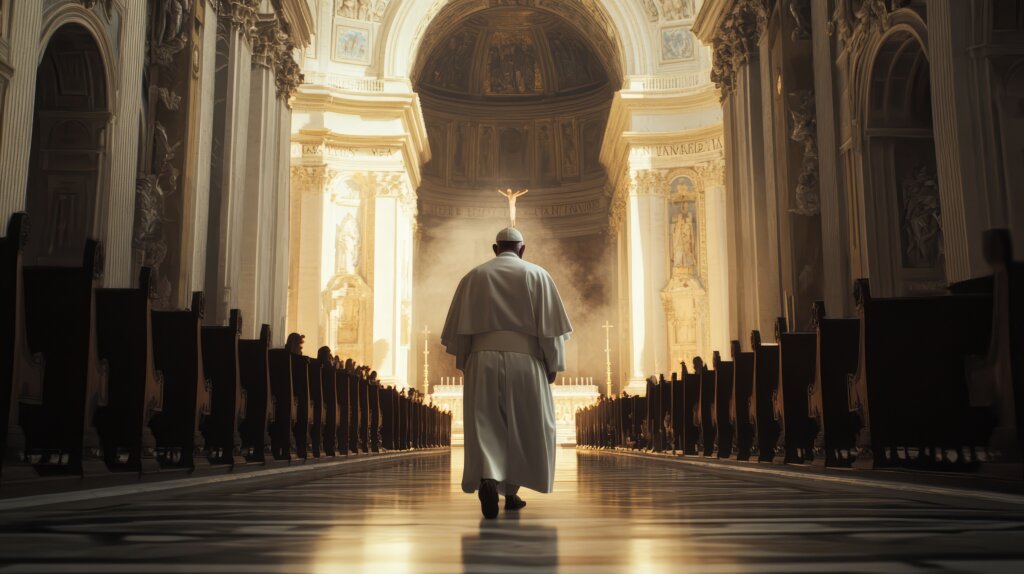
Pope Francis (1936-2025) was a beloved figure far beyond the global Catholic community he led. His open-hearted vision of humanity, ethics, and environmental justice marked him a a truly global leader who spoke from his heart, with the benefit of all beings at the forefront. Below is a selection of works from Shambhala Publications where his ideas were influential.
By Your Side: How to Find Soulful Allies and Become One to Others
by David Richo
Pope Francis equated praying for someone with accompanying him, a quality of an assisting force. Ordinations in Catholic ritual begin with a choir singing the “Litany of the Saints.” The choir sings out the name of a saint and the congregation sings back: 'Pray for us.' This call and refrain is an example of calling in, gathering the allies to bless the moment. Allies seem glad to assemble for us when we are open to them and invite them. It is not begging or demanding; it is invoking.


The Lost Art of Silence: Reconnecting to the Power and Beauty of Quiet
by Sarah Anderson
Sarah Anderson, the author of The Lost Art of Silence (and the owner of the bookstore featured in the Hugh Grant and Julia Robers film Notting Hill) included Pope Francis discussing another Shambhala author, Thomas Merton:
In 2015, Pope Francis even singled [Thomas Merton] out as worthy of study and as someone who opened new horizons for the church. Merton is often quoted and has become extremely influential in spiritual circles worldwide.
and
The 2015 Wim Wenders film Pope FrancisL A Man of His Word shows Pope Francis visiting the typhoon-ravaged Philippines. He tells the crowd, many of whom had lost members of their families as well as their homes, 'I don’t know what to tell you—I can only be silent. I accompany you silently in my heart.' That silence is more powerful than any words could have been.


A Wild Love for the World: Joanna Macy and the Work of Our Time
[Joanna Macy] also offers medicine for our moral ailments through her teachings on active hope. She interferes with anthropocentrism (what Pope Francis, in his encyclical Laudato Si on “the care of our common home,” rightly calls our narcissism as a species). She interferes by waking us up. She interferes by encouraging us to take our moral outrage at what is happening at human hands in the despoiling of Mother Earth and steer it to effective action, thus melting violence into nonviolence, reptilian brain energy into mammalian care.
and
A decisive factor for the rooting of the Work in Colombia is support from the well-known Jesuit peace worker Francisco de Roux, who participated in our first workshop in 2014. Thanks to his mediation, we receive funding from a British Catholic NGO that resonates strongly with Pope Francis’s Laudato Si and feels that our approach is a beautiful implementation of his ecological encyclical.

Life, Part 2: Seven Keys to Awakening with Purpose and Joy as You Age
By David Chernikoff
Pope Francis, the current head of the Catholic Church, offers us one last example of the way humor can support our awakening and our efforts to awaken others. Posted outside the door to his office is a sign that says, 'Complaining is forbidden. Offenders are subject to a syndrome of victimhood that reduces their sense of humor and capacity to solve problems. For anyone caught whining in front of children, sanctions will be doubled. To become the best of yourself, you must focus on your own potential and not on your limits. So stop complaining and act to change your life for the better.'


Into the Mirror: A Buddhist Journey through Mind, Matter, and the Nature of Reality
By Andy Karr
Having mentioned homeless people and panhandlers, I feel compelled to mention Pope Francis’s deep insights into how to really extend yourself to beings who are suffering: Speaking to the magazine Scarp de’ Tenis, which means tennis shoes, a monthly for and about the homeless and marginalized, the Pope said that giving something to someone in need is 'always right.' . . . But what if someone uses the money for, say, a glass of wine? (A perfectly Milanese question.) His answer: If “a glass of wine is the only happiness he has in life, that’s O.K. Instead, ask yourself, what do you do on the sly? What 'happiness' do you seek in secret?” Another way to look at it, he said, is to recognize how you are the 'luckier' one, Compassion in an Illusory World with a home, a spouse and children, and then ask why your responsibility to help should be pushed onto someone else. Then he posed a greater challenge. He said the way of giving is as important as the gift. You should not simply drop a bill into a cup and walk away. You must stop, look the person in the eyes, and touch his or her hands. The reason is to preserve dignity, to see another person not as a pathology or a social condition, but as a human, with a life whose value is equal to your own.


Triggers: How We Can Stop Reacting and Start Healing
By David Richo
Pope Francis in his encyclical Laudato Si’ wrote: “Our goal is . . . to dare to turn what is happening to the world into our own personal suffering and thus to discover what each of us can do about it.

Plea for the Animals: The Moral, Philosophical, and Evolutionary Imperative to Treat All Beings with Compassion
By Matthieu Ricard
As for Pope Francis, in his encyclical Laudato Si, he explains: 'When our hearts are authentically open to universal communion, this sense of fraternity excludes nothing and no one. . . . We have only one heart, and the same wretchedness which leads us to mistreat an animal will not be long in showing itself in our relationships with other people. Every act of cruelty towards any creature is ‘contrary to human dignity.’ He goes on: 'The Catechism firmly states that human power has limits and that 'it is contrary to human dignity to cause animals to suffer or die needlessly.'

The Buddhist and the Ethicist: Conversations on Effective Altruism, Engaged Buddhism, and How to Build a Better World
By Peter Singer and Ven. Shih Chao-Hwei
Pope Francis declared that 'the death penalty is inadmissible because it is an attack on the inviolability and dignity of the person' (this announcement is included in canon 2267 of the Church’s catechism). In the previous version of canon 2267, the Church reserved the death penalty for exceptional circumstances, 'only when capital punishment can protect people from being harmed by an aggressor.' Looking deeper, it emphasizes that in reality, 'the absolute necessity to execute the death penalty is so slim that it almost does not exist.' The 2018 version goes further, as seen in Pope Francis’s announcement, and asserts, 'The Church . . . works with determination for [the death penalty’s] abolition worldwide'


Green Buddhism: Practice and Compassionate Action in Uncertain Times
By Stephanie Kaza
In 2015, activists with Buddhist Peace Fellowship marched in Rome as part of the One Earth, One Family interfaith demonstration for Pope Francis. Their banner read, 'The whole Earth is my true body; I vow to work for climate justice.'


