A Series of Articles on Ngöndro
3. The Nyingma Traditiona
In our final article on ngöndro, we highlight some additional books and resources that support particular parts of the preliminary practices.
This is inspired by the words of Dzongsar Khyenste Rinpoche, who wrote in Not for Happiness:
"Although I refer most often to Jamyang Khyentse Wangpo’s commentary on the Longchen Nyingtik Ngöndro and the Chagchen ngöndro from the Kagyupa tradition, a great deal of excellent supporting literature is available for whichever ngöndro tradition you follow. Practitioners of the Longchen Nyingtik Ngöndro can refer to one of the most remarkable of all ngöndro commentaries, Patrul Rinpoche’s famous The Words of My Perfect Teacher, which is a series of direct, experiential pith instructions; practitioners of the mahamudra ngöndro can enrich themselves with The Jewel Ornament of Liberation by Gampopa, and many other texts; practitioners of Lam Dre (Path and Fruition) can consult the various Three Perceptions teachings from the Sakya traditions; and we must not forget the profound and excellent teachings of Lam Rim (the Gradual Path) by Tsongkhapa."

$22.95 - Paperback
This Precious Life: Tibetan Buddhist Teachings on the Path to Enlightenment
In Khandro Rinpoche's first book, she gives an extraordinary, heartfelt overview of the outer preliminaries.
You can listen to a sample of the audiobook here:
$22.95 - Paperback
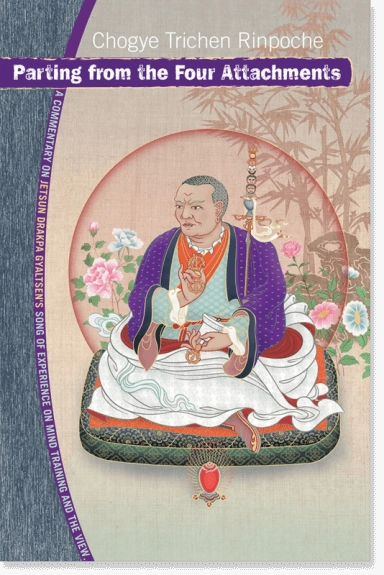
Parting from the Four Attachments: A Commentary on Jetsun Drakpa Gyaltsen's Song of Experience on Mind Training and the View
A classic text of the Sakya Tradition by Jetsun Drakpa Gyaltsen, explained by Chogye Trichen Rinpoche. The author gives some context:
"In Tibet also, among all the four main sects many great teachers have arisen to contribute to this tradition. One of them was the founding patriarch of the Sakya tradition, Sachen Kunga Nyingpo. At the age of twelve, through a direct realization of the Bodhisattva Manjushri, he received the teaching known as “The Parting From The Four Attachments” which brought him to a very profound understanding of the path to enlightenment. The teaching itself was only one verse of four lines, but its meaning included the entire path leading to Buddhahood."
The contents align closely with the outer preliminaries.

$21.95 - Paperback
The Flowing River of Dharma: Instructions on Parting from the Four Attachments Featuring Sakya, Kagyu, Nyingma, Kadam of Old, and Gelug Teachings
By Anyen Rinpoche & Allison Choying Zangmo
In the true spirit of the Rimé, Anyen Rinpoche and Allison Choying Zangmo weave together teachings from across traditions to bring forth the essence of mind training, or lojong, emphasizing the outer preliminaries in particular.
This draws on Patrul Rinpoche and Tsongkhapa, but in particular, the pithy teachings of Parting from the Four Attachments and the Four Dharmas of Gampopa. They show how these two essential teachings from different traditions complement each other and bring out the full richness of each other.
Also see our Reader Guide to Gampopa.
Here is a sample of the audiobook:

$39.95 - Paperback
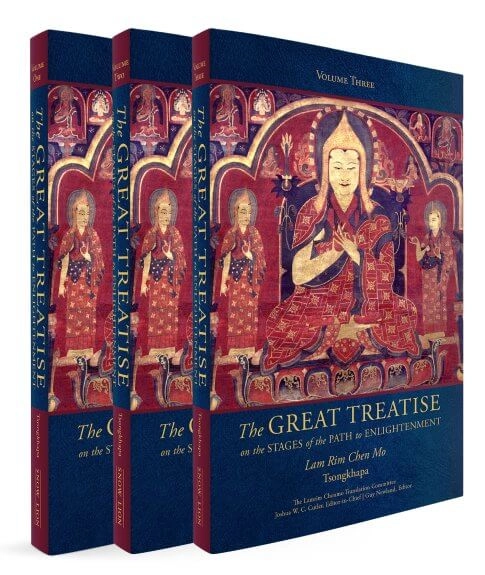
The Great Treatise on the Stages of the Path to Enlightenment
The Great Treatise on the Stages of the Path to Enlightenment (Tib. Lam rim chen mo) is one of the brightest jewels in the world’s treasury of sacred literature. The author, Tsong-kha-pa, completed it in 1402, and it soon became one of the most renowned works of spiritual practice and philosophy in the world of Tibetan Buddhism. Because it condenses all the exoteric sūtra scriptures into a meditation manual that is easy to understand, scholars and practitioners rely on its authoritative presentation as a gateway that leads to a full understanding of the Buddha’s teachings.
Tsong-kha-pa took great pains to base his insights on classical Indian Buddhist literature, illustrating his points with classical citations as well as with sayings of the masters of the earlier Kadampa tradition. In this way the text demonstrates clearly how Tibetan Buddhism carefully preserved and developed the Indian Buddhist traditions.
This first of three volumes—the one most relevent to ngöndro—covers all the practices that are prerequisite for developing the spirit of enlightenment (bodhicitta).
This second of three volumes covers the deeds of the bodhisattvas, as well as how to train in the six perfections.
This third and final volume presents two of the most important topics in the work: meditative serenity (śamatha) and supramundane insight into the nature of reality (vipaśyanā).
We hope you enjoyed this series of articles on ngöndro. If you have any feedback, please let us know.