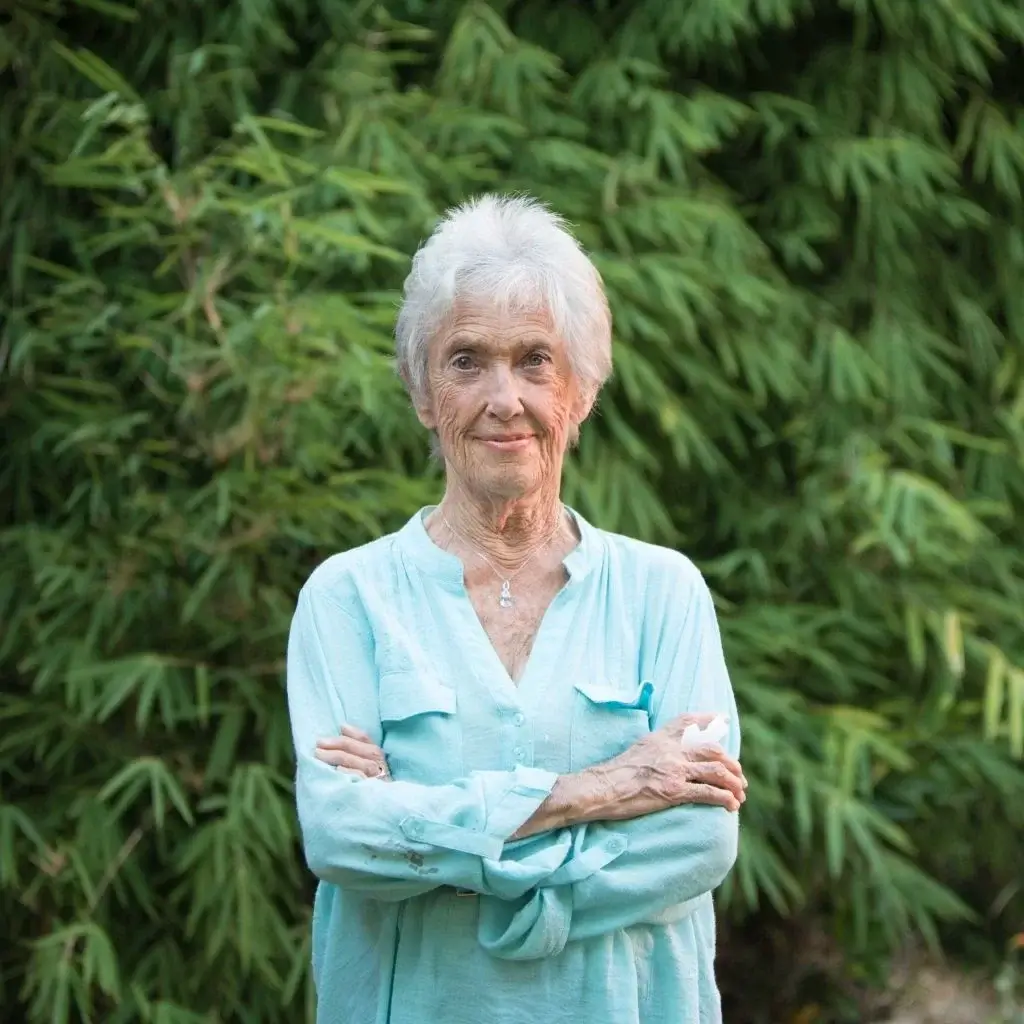
If the world is to be healed through human efforts, I am convinced it will be by ordinary people, people whose love for this life is even greater than their fear, people who can open to the web of life that called us into being, and who can rest in the vitality of that larger body.

—Joanna Macy

Joanna Macy passed away on July 19, 2025.  We join so many thousands in gratitude to a life very well-lived.  To honor Joanna and make her wisdom accessible to you, we put together the following guide.


A note from Shambhala Publications's president, Nikko Odiseos:

Joanna Macy's influence on me began in 1990 when my focus as an Environmental Studies major intersected with my burgeoning interest in Buddhism and a semester (followed by several more) studying and practicing in Bodhgaya, India.  Her World as Lover, World as Self, required reading in my curriculum, articulated ideas new to my hungry mind and gave form to the multiple connections I was discovering.

I met Joanna for the first time in 2015 shortly after Shambhala Publications had moved to Boulder and she was giving a talk.   We got together and discussed a wide variety of topics and out of that conversation came her two final books, the first two listed below.

She will be greatly missed.

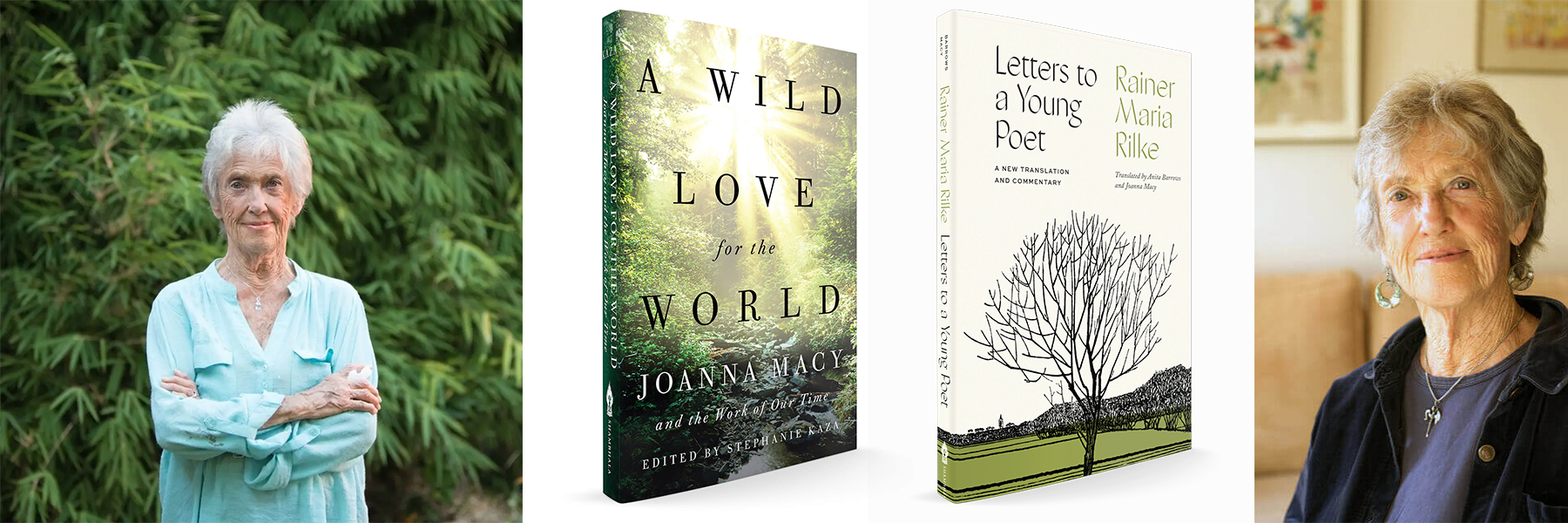
A Wild Love for the World
Paperback | Ebook 

$27.95 - Paperback

There is no better place to immerse yourself in the world of Joanna’s ideas than A Wild Love for the World: Joanna Macy and the Work of Our Time. This is a collective tribute that Stephanie Kaza orchestrated and  is filled with pieces by Joanna herself which frame each section  and several dozen people who have been inspired by Joanna’s vision and embodied her activity.

Stephanie Kaza enumerated the overarching themes explored in this book: “a planetary sense of self, the power of grief work, dependent causality, deep time, and taking up the work together. These are the gifts of a lifetime of reflection, insight, and thoughtful deliberation.”
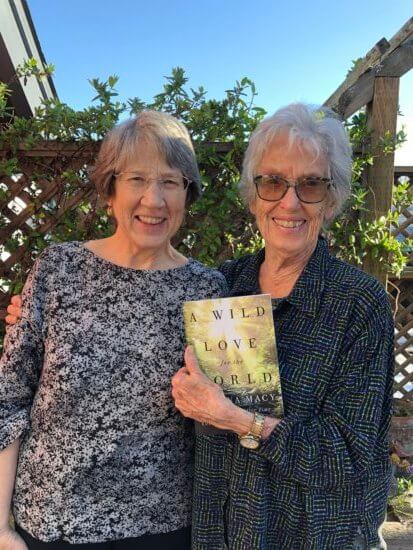
Stephanie Kaza Joanna Macy

Joanna Macy and Stephanie Kaza

Letters to a Young Poet
Hardcover | Ebook 

$18.95 - Hardcover

The most recent work of Joanna Macy, in partnership with her collaborator Anita Barrows (who recounts their connection over Rilke in Wild Love for the World), is the fresh and piercing translation of Rilke’s Letter to a Yong Poet.  In the introduction, they write:

"Rilke’s commitment to his art shaped his life. That commitment was so total that he expected it of young Kappus himself; if one is going to write poetry, one must feel as though death were the absolute consequence of not being permitted to write. The art Rilke pursued came at great cost; it demanded a deeply authentic response from body and soul to the natural world and to the raw experience of life. Rilke seemed unable to imagine expecting less from Kappus. While this can exalt many would-be poets, it also can be felt as a daunting and almost impossible condition".

This sounds very much like the model Joanna had for her own work.

Here she is reading from the book:

Paperback | Ebook 

$18.95 - Paperback

In Green Buddhism, frequent Macy collaborator Stephanie Kaza discussed her influence throughout and encapsulates "the Work" as follows:
An Excerpt from Green Buddhism

"The culmination of these foundations in her teaching and the fountain of collaborative creativity across Macy’s lifetime has now taken the form of what she calls 'the Work that Reconnects.' She sees this as a regenerating spiral, 'a source of strength and fresh insights. It reminds us that we are larger, stronger, deeper, and more creative than we have been brought up to believe.' The journey of empowerment travels through four movements: Coming from Gratitude, Honoring Our Pain for the World, Seeing with New Eyes, and Going Forth. Acknowledging gratitude grounds the work in appreciation for the wonder of being alive in the world, for loving what is important to us and feeling its true value. This naturally opens a floodgate of pain for the very fragility of all that we love. Through the skillful medicine of the work that reconnects, we perceive with new insight the wealth of resources available in the cosmic web of life, and this spurs us forward to be active agents in the web."

Buddha’s Daughters
Paperback | Ebook 

$24.95 - Paperback

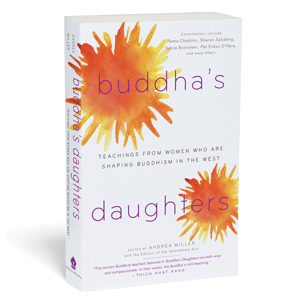
Lion's Roar editor Andrea Miller featured Joanna's "Gratitude: Where Healing the Earth Begins" in Buddha’s Daughters: Teachings from Women Who Are Shaping Buddhism in the West.

An Excerpt from Buddha's Daughters:

"We have received an inestimable gift. To be alive in this beautiful, self-organizing universe—to participate in the dance of life with senses to perceive it, lungs that breathe it, organs that draw nourishment from it—is a wonder beyond words. It is an extraordinary privilege to be accorded a human life, with self-reflexive consciousness that brings awareness of our own actions and the ability to make choices. It lets us choose to take part in the healing of our world."

Dharma Rain image
Paperback | Ebook 

$46.95 - Paperback

Dharma Rain: Sources of Buddhist Environmentalism is a superb collection of essays by the leading thinkers on the intersection of Buddhism and the natural world.  Unsurprisingly, four pieces by Joanna are included:

  • The Third Turning of the Wheel

  • Encouraging Words for Activists

  • Guarding the Earth

  • Spiritual Exercises for Social Activists

From The Third Turning of the Wheel

"The real philosophical grounding of my work comes from the Buddha’s central teaching of paticca samuppada or dependent coarising, the understanding that everything is intrinsically interrelated. The Buddha said, ‘‘He who sees the Dharma sees dependent co-arising, and he who sees dependent co-arising sees the Dharma.’’ When I first encountered Buddhism, the teaching of causality was the farthest thing from my interest or inclination; but after I explored it a little, I began to see what the Buddha meant by dependent co-arising, and how radical and profound that insight really was. With it—with his ‘‘turning of the wheel of the Dharma’’—he turned the thinking of his time on its head. And that teaching is central now to our enterprise of living and to our liberation."

Paperback | Ebook 

$19.95 - Paperback

Lion's Roar's Andrea Miller included Joanna's piece entitled "Three Lessons in Compassion" in All the Rage: Buddhist Wisdom on Anger and Acceptance

An excerpt from All the Rage

"I was standing with Choegyal [Rinpoche] under a rhododendron tree, the sunlight flickering on his face through the leaves and through blossoms the color of his robes. He had just divulged what must have been the most painful of his memories—what the Chinese military had done to his monks in the great prayer hall as his teachers hid him on the mountainside above the monastery. I gasped with shock and breathed hard to contain the grief and anger that arose in me. Then I was stilled by the look he turned on me, with eyes that shone with unshed tears.

'Poor Chinese,' he murmured.

With a shudder of acknowledgment, I realized that the tears in his eyes were not for himself or his monks or for his once great monastery of Dugu in the land of Kham in eastern Tibet. Those tears were for the destroyers themselves."

On Being's Krista Tippett wrote the following about Joanna for Wild Love for the World:

“The conversation I had with Joanna Macy early in our tender, tumultuous century has shaped me ever after. I first discovered Joanna through her gorgeous translations of the poet Rilke, a voice of the last century’s turnings that she has brought to accompany us in ours. I marvel at her many callings and adventures. She attended to the human trauma as Rilke’s central European world disappeared in the aftermath of World War II—and in the exile from Tibet of a young Dalai Lama. She was an environmentalist before that term was on every tongue. And she became a great Buddhist teacher before anyone understood how this tradition would meet twenty-first-century people and potentialities. Through all of this, Joanna has come to embody a singular clarity of vision about the totality of what it means to be human—at this moment in time. Her wild love for the world is a beacon to us all—and an exuberant invitation—to join our passion to hers, whatever the lives we lead. This book is a precious offering toward life-giving possibility.”
—Krista Tippett, host of On Being

Here is Krista Tippett in conversation with Joanna Macy:


returning
Paperback | Ebook 

$18.95 - Paperback

An author deeply influenced by Joanna is Jeanine Canty who is a contributor to Wild Love for the World.  Canty discusses Macy's influence in multiple places in her Nautilus Award winning Returning the Self to Nature: Undoing Our Collective Narcissism and Healing Our Planet

An Excerpt from Returning the Self to Nature

"I have mentioned the despair and empowerment work created by Joanna Macy and her colleagues. This work includes a strong focus on facing the emotional dimensions of the ecological crisis, and Macy developed it into a process called the “Work That Reconnects”—a kind of open-source and malleable set of views and practices that have inspired people around the world to practice with and build upon. I was first introduced to Macy’s work in the late 1990s. I was taking an ecopsychology class, and my teacher had recently returned from a workshop with Macy. She had a taped recording of some of the exercises and had us practice them. We initially starting walking slowly around the room; eventually we slowed down and connected with one another—staring into one another’s eyes, witnessing one another. The sense of connection this work spurs is profound—embodied and emotional—and cannot be conveyed in words. As I started teaching my own ecopsychology courses, I regularly facilitated Macy’s exercises. Within a few years, I met Joanna and have had the honor of knowing and working with her over the last couple of decades."

"

healing through dark emotions
Paperback | Ebook 

$24.95 - Paperback

Bestselling psychotherapist Mirian Greenspan features Joanna in Healing Through the Dark Emotions: The Wisdom of Grief, Fear, and Despair.

An Excerpt from Healing Through the Dark Emotions

"We live on an endangered earth. Though we may prefer to put this fact on the back burner of our consciousness, we all know it in our cells. The largescale systemic actions and inaction that imperil our world can be described as a form of violence called by some ecocide. In this context, says Joanna Macy, despair is inevitable and, no matter how individual, always has a transpersonal and global dimension. It is not a pathological condition or a deranged nihilism. “Rather, as it is being experienced by increasing numbers of people across a broad spectrum of society, despair is the loss of the assumption that the species will inevitably pull through.” Joanna Macy has been doing what she calls “despair work” for more than two decades. The work is designed to help people trust their despair and find individual and social empowerment through facing into it. Psychotherapy, argues Macy, has by and large ignored the social and global dimensions of despair and thus compounded the problem by isolating those who bear despair for the world.

A Practice from Joanna Macy from Healing Through the Dark Emotions

Exercise 17: Dark Emotions in the World

This exercise is adapted from the despair and empowerment work of Joanna Macy. It can be done alone or, preferably, in groups.

Start by placing an object in the four corners of the room to symbolize the grief, fear, despair, and anger in the world. When I do this exercise in groups, I place an autumn leaf in one corner, symbolizing the grief of the world; a rock in another, symbolizing the fear in the world; a stick in the third corner, symbolizing the anger in the world; and a crystal in the fourth corner symbolizing the world’s despair.


Now, sitting quietly, take a moment to contemplate each one of these corners. Starting with grief, close your eyes and contemplate the grief of the world at this moment in time. The various areas of the globe where people are in chronic states of ongoing sorrow. Think of the news stories you’ve read and seen on TV of people in various postures of grief: holding their hands over their eyes, weeping, bent over with sorrow, or embracing one another.

Now think also of the grief that you have in your heart for the world, its unending strife, conflict, violence, the degradation of the human and the nonhuman. The waste of human life, human potential, and the descent of the human spirit to the underworld of evil.

Now open your eyes and, if you are alone, write or create something out of your pain for the world. Then pray and ask for help or guidance in what you can do to consciously act for the amelioration of the world’s grief.

Do the same for fear, despair, and anger.

If you are doing this in a group, have each person speak from the heart about his or her dark emotions in relation to the world. Speak your emotions aloud with dignity, not shame. Allow one another to hear how deeply we feel this pain; how much it goes to the core of our being; how much of our own seemingly individual pain is connected to the larger pain of the world.

Write about this connection in your emotional alchemy journal.

Pray aloud with one another: May the world be liberated from its suffering.

May I use my own pain to grow in compassion. May we learn and help

one another learn how to heal and redeem the world’s suffering. Amen.

Profiles of Joanna Macy

turning words
Paperback | Ebook 

$18.95 - Paperback

An Excerpt from Turning Words:

“...today’s times are perilous, and hope can be hard to find. Joanna and I have frequently discussed this, and—of course—people ask her about it all the time. Joanna writes:

In all great adventures there comes a time when the little band of heroes feels totally outnumbered and bleak, like Frodo in The Lord of the Rings or Pilgrim in Pilgrim’s Progress. You learn to say “It looks bleak. Big deal, it looks bleak.”

We talked about this, and she expands on the metaphor, explaining that Frodo’s task was simply to carry the Ring to Mount Doom. That was his job, impossible when you think about it. But Joanna answers the challenge—Frodo’s and our own—“We just have a job to do. Don’t waste my time.”

meetings with remarkable women
Paperback | Ebook 

$34.95 - Paperback

Lenore Friedman profiles Joanna in Meetings with Remarkable Women: Buddhist Teachers in America.

An Excerpt from Meetings with Remarkable Women

"As things fall apart, as systems break down, people begin to scapegoat each other, and fear grows. I want to give people resources to cope with panic and fear and social hysteria so we can get through this time without turning on each other, but with the full dignity and majesty of our journey on earth until now. As we go back and look at how beautiful our evolutionary journey has been, then this current crisis is a big one all right, but we realize how much we've got going for us in terms of our own adaptability and in terms of the mysterious adaptability of life. This, too, can help us move beyond fear, because fear is a contraction of the heart."

Joanna Macy on Being a Shambhala Warrior

Stephanie Kaza

From Green Buddhism:

"It has been my great honor to know and work with Joanna Macy across the past thirty years and to be challenged to transmit this work to students and colleagues. In my mind’s eye, I see her in the open meadow at Shenoa Retreat Center, surrounded by trees, a fierce bodhisattva warrior for the Earth. She stands firm, touching the Earth as witness, her open heart and shining mind fearless in this call to care for the Earth. For me and thousands of others, she is a beacon of courage and compassion in difficult times. Always I see her smiling face radiant with love."
—Stephanie Kaza