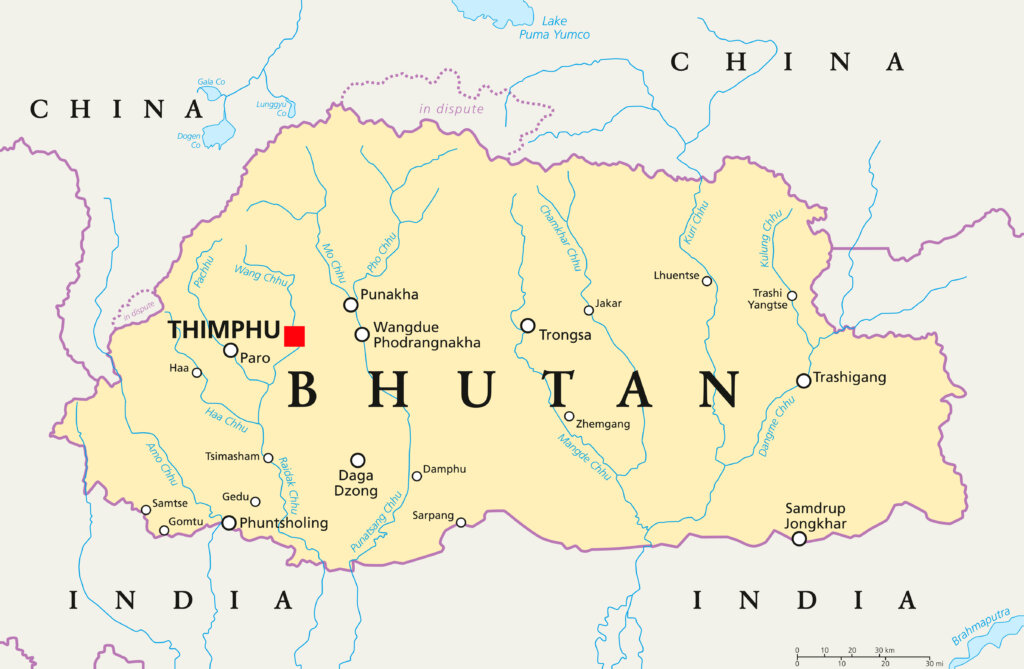
bhutan map

Bhutan is a magical kingdom, where a deep Buddhist outlook of the people and forward-thinking royal family along with religious leaders from the Nyingma and Drukpa Kagyu traditions have managed to preserve Bhutan while opening it up to visitors in a remarkable threading of a needle.

We have multiple books on Bhutan, the sacred Buddhist places and the accomplished masters that have come from there. This reader guide has something for everyone.

Ascent of the Thunder Dragon: The Surprising Spiritual Life and Legacy of Bhutan’s Founder

Sasha Wakefield intertwines the life and legacy of Zhabdrung Ngawang Namgyal (1594–1651) with her own personal spiritual journey as she explores Bhutan’s rich history.

The seventeenth century was a pivotal time for the tiny but culturally vibrant kingdom of Bhutan—marked especially by the life of the influential political and spiritual leader Zhabdrung Ngawang Namgyal (1594–1651), including his remarkable past lives. Sasha Wakefield traces the life and profound spiritual accomplishment of this master in the context of her own spiritual journey from Australia to Bhutan. While unveiling the cultural and spiritual landscape of Bhutan, Wakefield delves into the fundamental Buddhist concepts of reincarnation, karma, bodhisattvas, buddhas, and enlightenment to underscore the significance of Zhabdrung’s spiritual attainment, including reaching the tenth bhumi, or level, of a bodhisattva, and deliberately choosing his own rebirth.

During Zhabdrung’s time as early nation-builder of the kingdom and state of Bhutan, he faced adversity and attacks from adversaries but responded with meditation, diplomacy, and unwavering commitment to serve the people of Bhutan. Wakefield shows the nature of ritual and ceremony that are inherent in the history of the Bhutanese state, weaving in the verse texts of liturgies and praises for the offering ceremonies and consecrations that were central to establishing the Drukpa Kargyu Buddhist lineage in Bhutan and establishing Bhutan as a sovereign land.

"A work from the heart, which both reflects a profound personal experience and an insightful, spirited, and well-researched account of the life and world of a remarkable teacher who shaped Bhutan as it is today and whose spiritual legacy remains vividly alive."

Matthieu Ricard, author of A Plea for the Animals


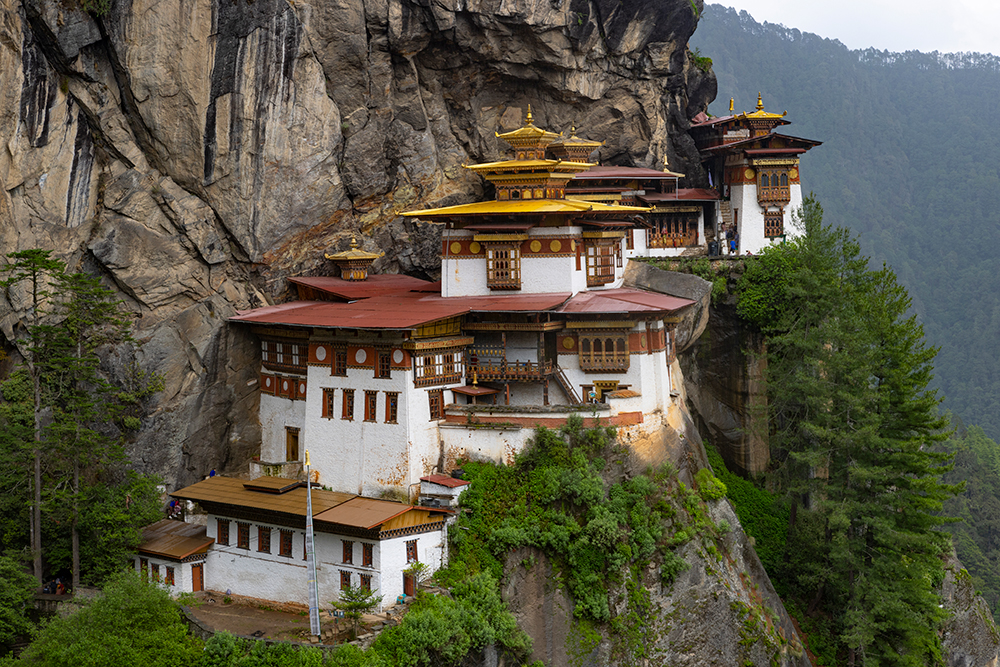
Taktsang
The iconic Taktsang or Tiger's Nest, one of the most important sites of Guru Rinpoche

Guru Rinpoche: His Life and Times

Padmasambhava, or Guru Rinpoché, was the Indian master said to have established Buddhism in Tibet in the eighth and ninth centuries. His impact on Bhutan where  he sent a significant amount of time cannot be overstated.  The first Zhabrung, profiles in Ascent of the Thunder Dragon, is considered his emanation.

This book includes four accounts of his life by prominent Tibetan scholars, and includes supplications and Buddhist poetry praising him, as well as a substantial introduction and appendixes by Ngawang Zangpo.

In traditional Tibetan history, Guru Rinpoché is known as having fostered radical changes to Tibet, marking historic transformations in the country’s religious and political position, founding its first monastery Samye and being involved in ordaining its first monks. To Tibetan Buddhists, Guru Rinpoché is also a buddha and serves as the center of practice traditions. These four biographies show both a historical figure in a particular geopolitical landscape and a realized being born in the middle of a lotus, hence his epithet, the Lotus Born.

See also our Reader Guide to Guru Rinpoche Padmasambhava


"The memory of his shockingly confident, authentic presence is unforgettable, along with his tireless enthusiasm to benefit others accompanied with profound lineage transmissions mostly given by heart. In these times, when meeting such an authentic master is as rare as a daytime star, this book—like the sighting of a Golden Garuda—gives us a renewed sense of hope and faith in the timeless wisdom of the Mahayana, Vajrayana, and Ati Yoga traditions."
Sangye Khandro, cofounder of Light of Berotsana Translation Group

Gypsy Gossip and Other Advice

Gypsy Gossip is an extraordinary book from one of the greatest masters of our time, Thinley Norbu Rinpoche, the son of Dudjom Rinpoche and father of Dzongsar Khyentse Rinpoche, who had deep ties to Bhutan and is much revered there.

One of the pieces in this collection is "A Message for Young Bhutanese", and there is specific advice for Bhutanese to keep in their hearts, though of course much of the advice Rinpoche imparts is universal, for us all.

From Gypsy Gossip:

"Although Bhutan is a tiny country, it is blessed by Guru Rinpoche to be a pure Dharma country, which was further established by many sublime beings, including Phajo Drugom Shigpo,24 Omniscient Longchenpa, Pema Lingpa, and Shabtrung Rinpoche, all of whom did not discriminate between Old School (Nyingma) and New School (Sarma) traditions but taught to keep faith in Guru Rinpoche unshakably. From this great legacy, Bhutan is one of the most stable places in which pure Dharma traditions have been maintained. If religious leaders follow whatever traditions flourished previously in the same way, it will be very uncomplicated and much more beneficial for all. It will not cause contradiction between Nyingma and Drukpa Kagyu, but will continue the recognition of Guru Rinpoche as being not only for Bhutan, but the sole wisdom emanation of Buddha Shakyamuni and the protector of the entire world, including the people of Bhutan. I cannot say what the karma of the younger generation in Bhutan will be in the future, but it is certain that it is much better for Bhutanese to encourage Buddhism to flourish than to ignore it, for the benefit of all beings, including Bhutanese."

King of Empty Plain: the Tibetan Iron-Bridge Builder Tangtong Gyalpo
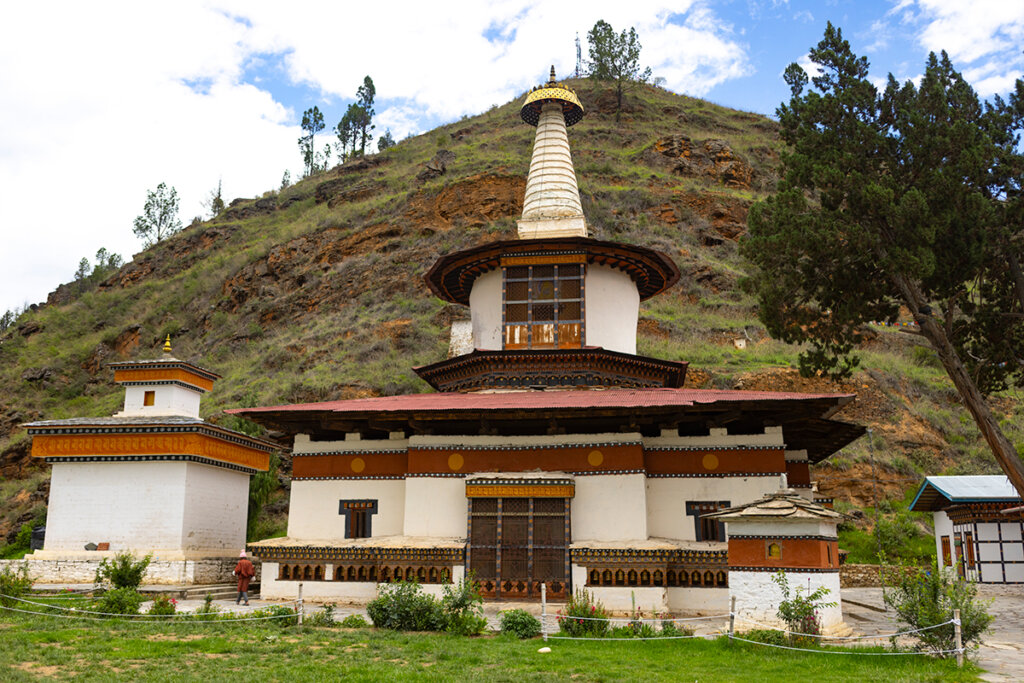
Dumtseg Lhakhang
Dumtseg Lhakhang, an important an incredible temple built by Tangtong Gyalpo

King of the Empty Plain: The Tibetan Iron-Bridge Builder Tangtong Gyalpo

Tangtong Gyalpo is familiar to every Bhutanese and Tibetan yet nearly unknown in the rest of the world. His incredible lifespan (much of it in Bhutan), profound teachings, unprecedented engineering feats, eccentric deeds, and creation of Tibetan opera have earned this fascinating figure a unique status in Tibetan and Bhutanese culture. Believed to be the great Indian master Padmasambhava appearing again in the world to benefit living beings, he discovered techniques for achieving longevity that are still held in highest esteem and are frequently taught six hundred years later. His construction of fifty-eight iron suspension bridges, sixty wooden bridges, 118 ferries, 111 stupa monuments, and countless temples and monasteries in Tibet and Bhutan remains an awe-inspiring accomplishment.

This book is a detailed study of the life and legacy of this great master. An extensive introduction discusses Tangtong Gyalpo's Dharma traditions, the question of his amazing longevity, his "crazy" activities manifested to enhance his own realization and to benefit others, and his astonishing engineering and architectural achievements. The book includes a complete translation of the most famous Tibetan biography of Tangtong Gyalpo, as well as the Tibetan text and English translation of a unique early manuscript describing his miraculous death. The text is further enriched with ten color plates and seventy-seven black-and-white illustrations.

"This represents the culmination of many years of patient scholarship and contemplation of the problems of meaningful translation into English. . . . The author has selected a figure of enormous importance for the cultural context of Tibetan Buddhism. This is a book that will last."
—E. Gene Smith, executive founder of the Buddhist Digital Resource Center

Brilliant Moon: The Autobiography of Dilgo Khyentse

When Dilgo Khyentse Rinpoche escaped from the Chinese invasion of Tibet, it was in Bhutan that he settled, at the invitation of the King Jigmey Dorje Wangchuk and the Queen Mother—now Royal Grandmother—Ashi Kesang Chödrön Wangchuk that he settled.  Much of his life in Bhutan is included in Brilliant Moon, but there is also a very special account by Her Majesty the Royal Grandmother of her recollections of her teacher and his life in Bhutan.

It is an incredible testament to the vast activity of Dilgo Khyentse Rinpoche in Bhutan. Here is how Her Majesty concludes her remarkable set of recollections:

"Thus, because the great masters from Tibet were forced to escape their homeland and settle in India and Nepal, Dilgo Khyentse, whose kindness can never be repaid, came to live in the medicinal valleys of Bhutan. He came to Bhutan through the power of past karma and prayers to guide fortunate students with the nectar of the sacred Dharma, to act for the welfare of the doctrine and beings. From the time he arrived at the border in 1959 until he passed away in Thimphu Hospital in 1991, Dilgo Khyentse blessed and protected Bhutan. Through his special blessings and protection for His Majesty the King of Bhutan, the royal family and all the people of Bhutan enjoy peace and happiness and are always surrounded by Khyentse Rinpoche’s unceasing blessings, even today. Bhutan is very fortunate to enjoy the presence of Khyentse Rinpoche’s reincarnation, Yangsi Rinpoche, who continues to bless our kingdom."

For an exquisite profile of Her Majesty the Royal Grandmother, we highly recommend reading Dzongsar Khyentse Rinpoche's account from his ongoing autobiographical online work, Mugwort Born.

Divine Messengers: The Untold Story of Bhutan’s Female Shamans

by Stephanie Guyer-Stevens and Francoise Pommaret

As mystics, healers, and travelers to the netherworld, female shamans continue to impact the spiritual lives of the Bhutanese. These divine messengers act as mediums for local spirits, cure diseases through prayer, and travel to the realm of the dead. They are sometimes referred to as “sky-goers,” “reincarnations,” or “returners from the beyond,” and their stories are intimately connected with the Buddhist ideas of karma and rebirth.

Journalist Stephanie Guyer-Stevens and anthropologist Françoise Pommaret traveled to the Himalayas to meet seven living Bhutanese female shamans and to help make their stories known. Stephanie and Françoise offer an intimate narrative of these shamans’ spiritual experiences and important roles in society. This book also provides an overview of the history of this tradition and a translation of an autobiography of the famous eighteenth-century divine messenger, Sangay Choezom. This insightful and sensitive account is a rare look inside the world of these brave women.

"I love and admire the book and the great work both Françoise and Stephanie did in tracking down and relating with all the khandroms and deloms and divine messengers all over Bhutan, and the clear and sensitive thought and writing that went into the fascinating book. . . . Just amazing."
—Robert Thurman

Tales of a Mad Yogi: The Life and Wild Wisdom of Drukpa Kunley

by Elizabeth Monson

The fifteenth-century Himalayan saint Drukpa Kunley is a beloved figure throughout Tibet, Bhutan, and Nepal, known both for his profound mastery of Buddhist practice as well as his highly unconventional and often humorous behavior. Ever the proverbial trickster and “crazy wisdom” yogi, his outward appearance and conduct of carousing, philandering, and breaking social norms is understood to be a means to rouse ordinary people out of habitual ways of thinking that leads them toward spiritual awakening.

Elizabeth Monson has spent decades traveling throughout the Himalayas, retracing Drukpa Kunley’s steps and translating his works. In this creative telling, she has reimagined his life based on historical accounts, autobiographical sketches, folktales, and first-hand ethnographic research. The result, with flourishes of magical encounters and references to his superhuman capacities, is a poignant narrative of Kunley’s life, revealing to the reader the quintessential example of the capacity of Buddhism to skillfully bring people to liberation.

"A literary gem—reimagining the elusive Drukpa Kunley, based on exacting research and blended with lucid translations. Elizabeth Monson gives narrative flesh to the bare biographical bones found in his collected writings. The ‘mad saint’ comes to life, ever the social critic but more human and profound than in the folktales previously available in English."
—Holly Gayley, associate professor of Buddhist Studies at the University of Colorado, Boulder

The Life and Revelations of Pema Lingpa

Translated by Sarah Harding, foreword by Gangteng Rinpoche

The Life and Revelations of Pema Lingpa offers an extensive and multifaceted exploration of the life, spiritual legacy, and cultural significance of Pema Lingpa (1450–1521), one of Bhutan’s most revered Buddhist saints and tertöns (treasure revealers). Rooted deeply in Bhutanese soil, Pema Lingpa is portrayed not only as a pivotal religious figure but also as a symbol of Bhutanese identity, whose teachings and revelations have profoundly shaped the nation’s spiritual and cultural landscape.

Central to the narrative is the terma tradition within Vajrayana Buddhism, particularly the Nyingma school, which involves the concealment and later revelation of sacred teachings and ritual objects by Padmasambhava and his consort Yeshe Tsogyal. Pema Lingpa, recognized as one of the Five Tertön Kings, is celebrated for uncovering numerous earth terma treasures, notably the Lama Jewel Ocean cycle, which forms the doctrinal and ritual foundation of the Peling tradition in Bhutan. His miraculous discovery at Burning Lake (Mebartso), fulfilling ancient prophecies, cemented his legitimacy and spiritual authority.

The book delves into the theological framework of the treasure tradition, emphasizing the transmission of wisdom from the ultimate dharmakaya through sambhogakaya to nirmanakaya, linking cosmic enlightened realms with earthly manifestations. It highlights the complex stages of treasure concealment and revelation, the role of spiritual guardians, and the importance of prophecy in authenticating the tertön’s mission.

Pema Lingpa’s life narrative weaves together visionary experiences, miraculous feats, and humble human qualities. His spiritual journey is marked by trance states, encounters with dakinis, public tests of authenticity, and profound visionary guidance from figures like Yeshe Tsogyal. His revelations are not merely textual but embodied in ritual dances, festivals, and community institutions that continue to thrive in Bhutan.

The socio-political impact of Pema Lingpa’s legacy is significant. His descendants, particularly the Nyö clan, played instrumental roles in Bhutan’s political consolidation, with his spiritual authority intertwined with secular governance. The tulku system perpetuates his presence through successive incarnations, maintaining religious institutions and practices.

The book also addresses the nuanced role of women within the Vajrayana treasure tradition, candidly portraying the challenges faced by female practitioners and their spiritual potential, as reflected in dialogues preserved in Pema Lingpa’s treasure texts. The prominence of dakinis and female disciples underscores a complex interplay between gender, spirituality, and societal constraints.

Doctrinally, the text elaborates on core Vajrayana teachings such as refuge in the three kayas, cultivation of bodhichitta, merit and wisdom accumulation, purification practices, and the indispensable role of the lama. It details the ten modes of conduct for practitioners and the creation and completion phases of tantric meditation, emphasizing the inseparability of emptiness and appearance.

Interwoven are rich historical contexts, including the foundational role of Padmasambhava in establishing Buddhism in Tibet, the royal patronage of King Trisong Detsen, and the sanctification of Himalayan sacred geography. The treasure tradition is situated as a dynamic, living lineage that adapts to the challenges of degenerate times, marked by moral decline and false practitioners, yet sustained by authentic adepts and rigorous practice.

The scholarly discourse acknowledges critical perspectives on the terma tradition but emphasizes the cultural, religious, and symbolic significance of visionary narratives and ritual authenticity. The extract thus presents Pema Lingpa as both a historical and living presence whose spiritual revelations continue to animate the religious, cultural, and political fabric of Bhutan and the greater Himalayan region.

In sum, the book offers a comprehensive, richly detailed portrait of Pema Lingpa’s treasure tradition, blending biography, theology, ritual practice, gender dynamics, and socio-political history. It underscores the enduring vitality of Vajrayana Buddhism in Bhutan, the transformative power of terma revelation, and the profound legacy of a master whose life and teachings remain central to Himalayan spiritual culture.

More Resources

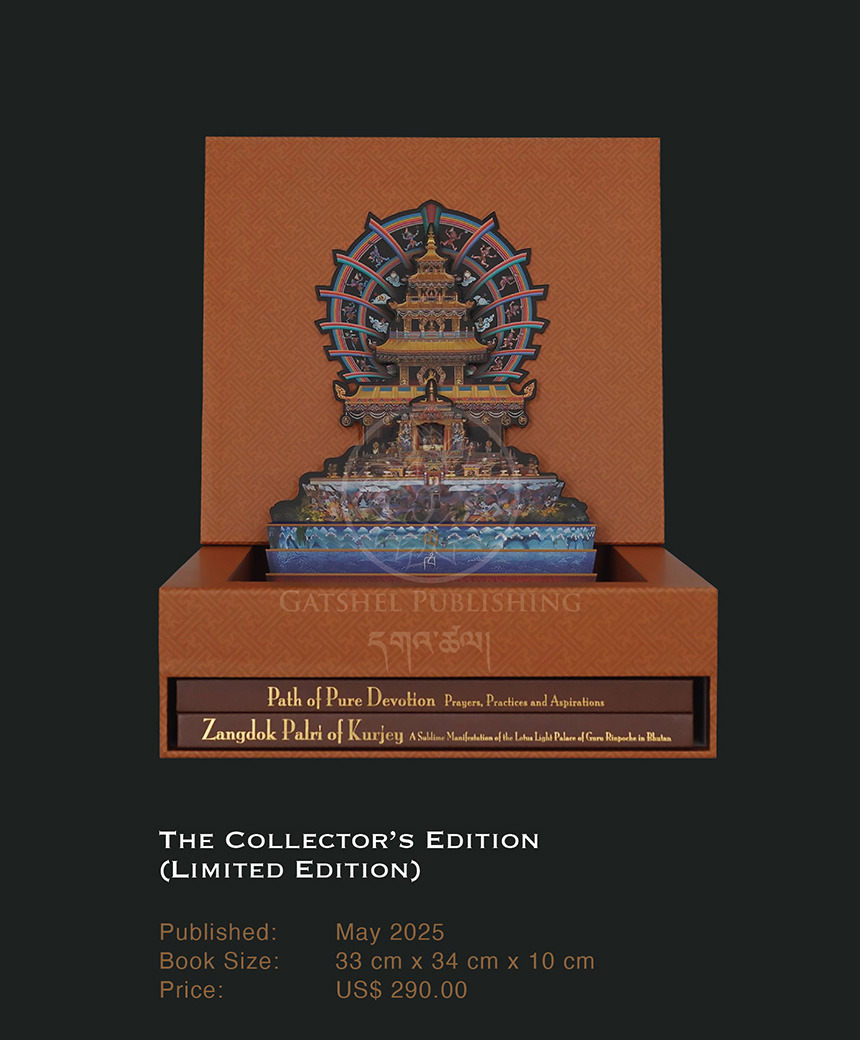
There are of course many other books on Bhutan.  We wanted to share one other publisher who does incredibly beautiful books on Bhutan.

https://gatshel.com/


And for an excellent history of Bhutan, we recommend Karma Phuntsho's History of Bhutan.

Also, we recommend Following in Your Footsteps, Volume III which includes some of Guru Rinpoche's time in Bhutan.