


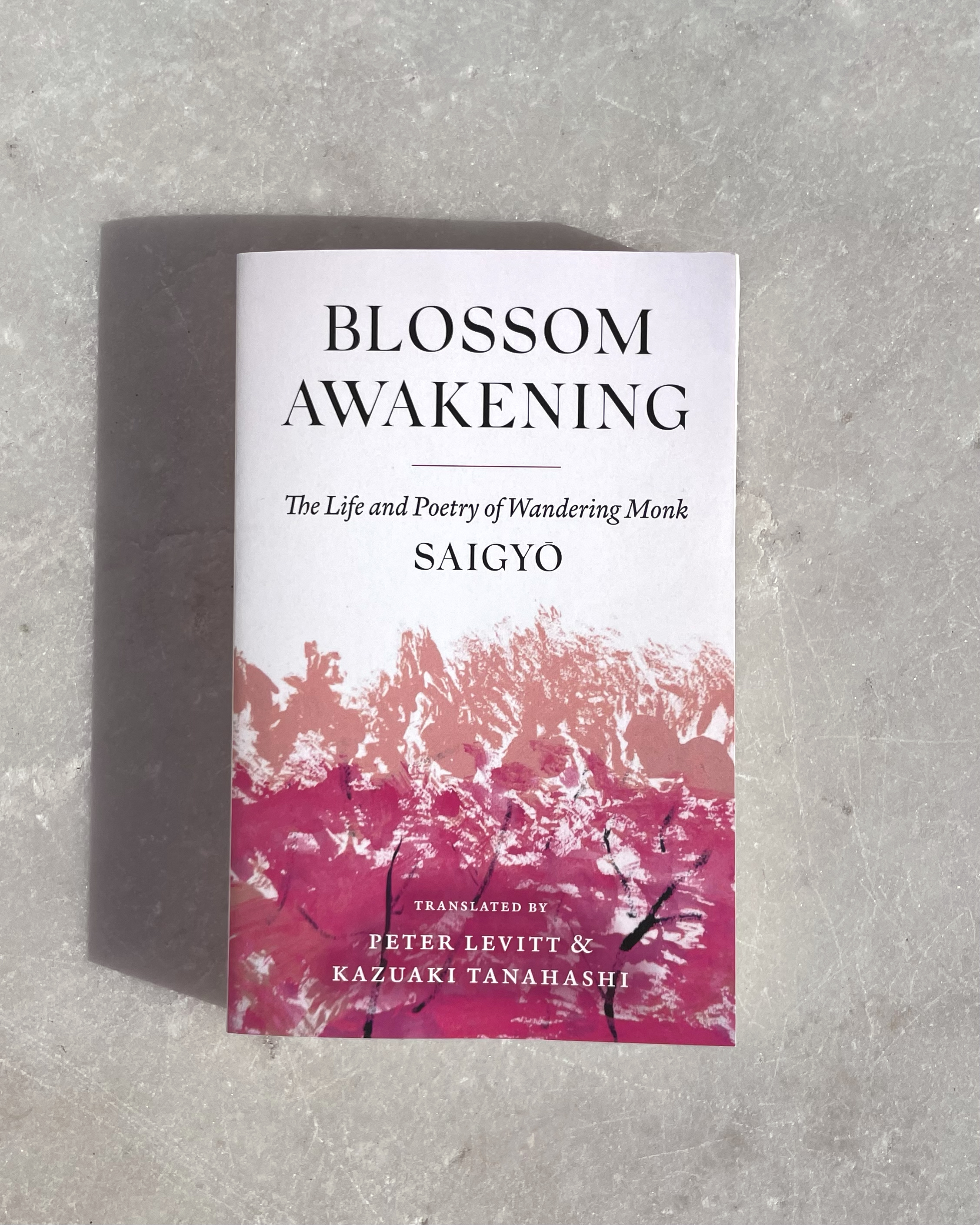
Blossom Awakening
By Saigyo
Translated by Peter Levitt
Translated by Kazuaki Tanahashi


-
Amazon eBook Download
Privacy PolicyBefore you go, sign up to receive news & promotions from Shambhala.com
Apple eBook Download
Privacy PolicyBefore you go, sign up to receive news & promotions from Shambhala.com
Google eBook Download
Privacy PolicyBefore you go, sign up to receive news & promotions from Shambhala.com
Kobo eBook Download
Privacy PolicyBefore you go, sign up to receive news & promotions from Shambhala.com
Nook eBook Download
Privacy PolicyBefore you go, sign up to receive news & promotions from Shambhala.com
Shambhala Publications07/15/2025Pages: 312Size: 5.5 x 8.5ISBN: 9781645473633Details
Translators Peter Levitt and Kazuaki Tanahashi. Photo by Candace Cole
Pause, breathe, and savor the quiet beauty of Saigyō, one of Japan’s most quintessential poets, in this celebration of nature and Buddhist insight.
Born in the twelfth century during a time of great political upheaval and warfare, Saigyō made the unusual decision in his youth to resign from his respectable post as a guard to the emperor’s family and pursue a life of Buddhist renunciation, wilderness wandering, and poetry. Over the course of his lifetime, he became one of Japan’s most celebrated poets. Today, his spare poems of spiritual longing and aching identification with the natural world continue to inspire fathomless, ineffable emotion in readers all over the world.
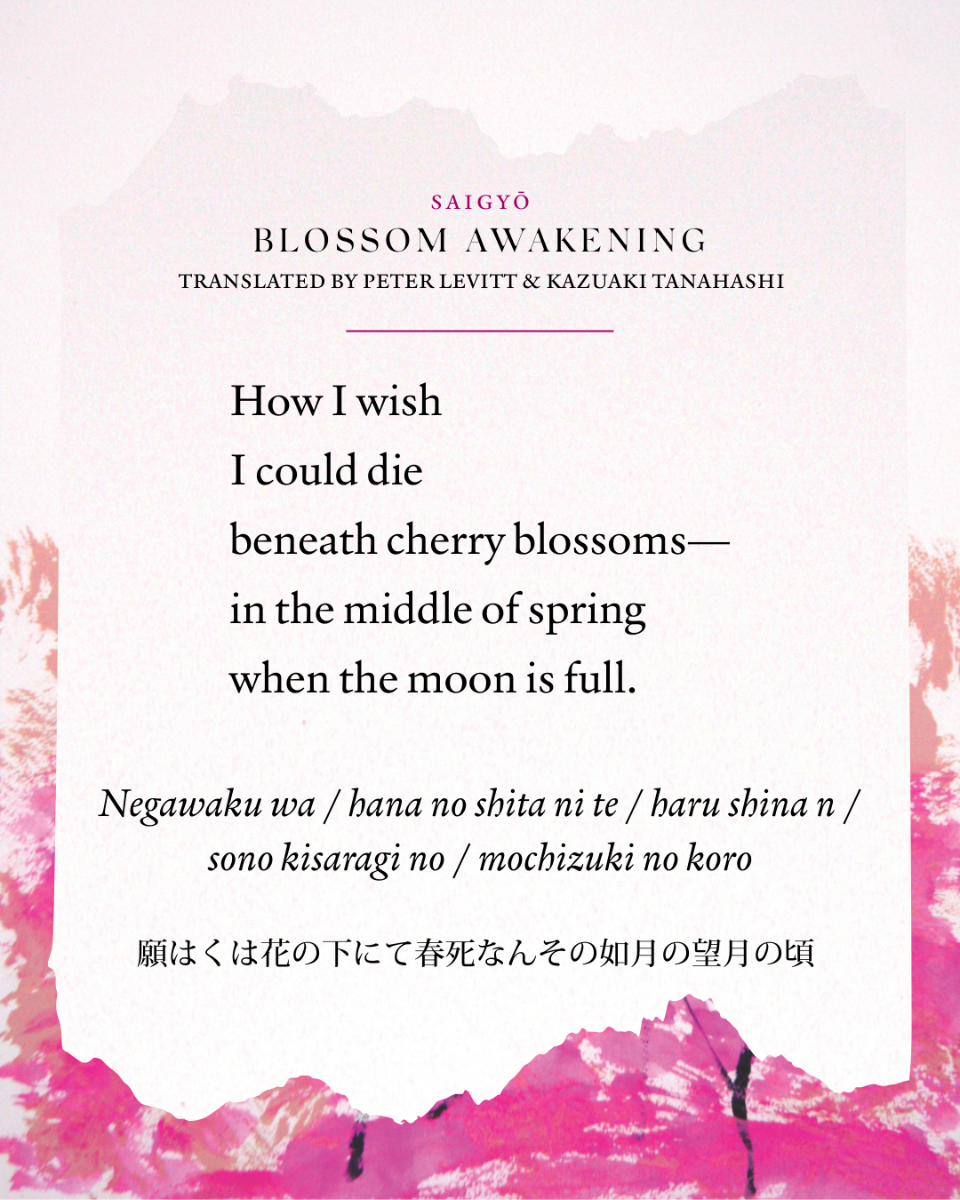
With 193 poems on 11 themes like the moon, journeys, mountain abodes, love, and the dreamlike world, Blossom Awakening reveals Saigyō as a spiritual seeker who gave his life to the artist’s path. Translators Peter Levitt and Kazuaki Tanahashi present their English renderings with the original Japanese text and offer commentary that illuminates the political, religious, and literary dimensions of Saigyō’s life and work.RelatedCheck items to add to the cart orAuthor BioSaigyō (1118-1190, born Norikio Satō) is among Japan’s most celebrated and enduring poets. As a young man, he was a samurai and served as a low-class imperial guard. A brief love affair with the highest-ranking lady in the court, and a strong desire to be free from violence, drove him to leave the life he knew to become a devoted Buddhist monk who lived in solitude and wandered near and far. His wandering life was profoundly intimate with the natural world, and his time immersed in nature inspired his deeply felt poetry. Saigyō’'s genre was waka, a one-column poem consisting of phrases comprising five, seven, five, seven, and seven syllables. During his lifetime, war and a major political shift from imperial to military administration devastated the people and the land, but Saigyō was a friend to all people. He exchanged poetry with an exiled emperor, former court ladies, a prostitute, and renowned poets. And in one seminal poem that voices his intimate feeling and identification with the natural world and his life as a monk, he expressed the desire to die close to the day of the Buddha’s passing in the middle of spring, while sitting beneath a full moon with a canopy of cherry blossoms blooming overhead. He managed to accomplish this as his last poetic expression. Peter Levitt is a poet and translator whose numerous books of poetry include One Hundred Butterflies and Within Within. In addition, he is the author of Fingerpainting on the Moon: Writing and Creativity as a Path to Freedom. He is the guiding teacher of the Salt Spring Zen Circle in British Columbia.
 KAZUAKI TANAHASHI, a Japanese-trained calligrapher, is the pioneer of the genre of “one-stroke painting” as well as the creator of multicolor enso (Zen circles). His brushwork has been shown in exhibitions in galleries, museums, and universities all over the world. Tanahashi is the author of over forty books, including Painting Peace, Heart of the Brush, and The Heart Sutra.Praise
"Saigyō has long been regarded as the ultimate Buddhist poet. Living a lonely life of wandering and renunciation during a period of great turmoil, Saigyō was as often moved to tears by the beauty of flowers and the moon as he was by the pain of the violence of the world he lived in. Levitt and Tanahashi’s great translations carry across into English the elegant simplicity and quiet emotion of the original poems that have been loved for a thousand years in Japan and all over the world. Tanahashi’s extensive historical introduction gives us a strong impression of the confusing social and political passions that marked Saigyō’s time." —Norman Fischer, poet and Zen priest, author of Selected Poems and Training in Compassion
"Even as Levitt and Tanahashi hear the sound of a storm murmuring in a tree’s branches––echoing social storms raging in Saigyō’s times and ours––they dwell in mountainous depths. Like Saigyō, they, too, know ‘the moon in your mind becomes a clear mirror,’ and they ‘see enlightenment all around.’ Feeling the sky in Saigyō’s heart, they offer illuminating, aesthetically refined renderings of his poetry, enabling us to commune with nature, to hear the whispers of the moon, and to be serenaded by the cherry blossoms." —Paula Arai, PhD, author of Painting Enlightenment: Healing Visions of the Heart Sutra
"What a beautiful book! A perfectly selected set of gorgeous, limpid translations by two contemporary masters. Full of feeling and clear awakening, these wonderful, brief poems of wandering Japanese poet-monk Saigyō convey the depth and beauty of his vision of this fleeting world and life. A masterwork!" —Henry Shukman, author of One Blade of Grass and Original Love
"This is a beautiful and haunting book. Saigyō reaches across the centuries and reveals the intimate way for us today." —James Ishmael Ford, author of The Intimate Way of Zen: Effort, Surrender, and Awakening on the Spiritual Journey
Selected Reader Reviews


